
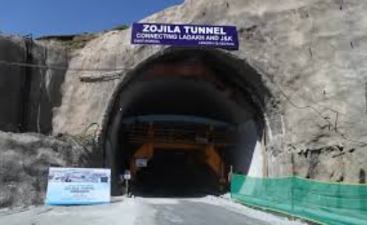
Union Minister for Road Transport and Highways Nitin Gadkari recently triggered the final controlled blast marking the breakthrough of the main Zojila Tunnel at Minimarg in Ladakh. The 13.153-kilometer-long high-altitude engineering project connects Baltal near Sonamarg in Jammu and Kashmir with Minamarg near Drass in the Kargil district of Ladakh. Executed by Megha Engineering and Infrastructure Limited (MEIL) for the National Highways and Infrastructure Development Corporation Limited (NHIDCL) at an estimated cost of ₹6,809.69 crore, this project establishes a historic milestone toward permanent land integration. The project is targeted for its final public commissioning by February 2028.
Geographic and Structural Architecture
The Zojila Tunnel is a greenfield project engineered to handle heavy high-altitude transit requirements.
Altitude and Location
The infrastructure is built beneath the treacherous Zoji La Pass on National Highway 1 (NH-1) at an elevation of approximately 11,578 feet (3,528 meters) above sea level. This pass experiences sub-zero temperatures dropping between -20°C and -30°C for nearly 100 days a year.
Structural Dimensioning
The construction features a horseshoe-shaped configuration measuring 9.5 meters in width and 7.57 meters in height. As a single-tube, bi-directional passageway, it ranks as the longest road tunnel of this type at such extreme altitudes globally.
Integrated Approach Infrastructure
The main tunnel is part of a larger 31-kilometer project layout. This includes eight distinct cut-and-cover avalanche protection sections spanning 2.35 kilometers, three vertical ventilation shafts (reaching depths down to 480 meters), and nearly 18 kilometers of reinforced approach roads and bridges.
Advanced Engineering and Design Safety Systems
Building a deep mountain transport corridor through fragile rock layers required advanced technical methods and modern emergency infrastructure.
New Austrian Tunnelling Method (NATM)
Engineers used the New Austrian Tunnelling Method to navigate the complex Himalayan geology. NATM relies on active monitoring and uses the inherent strength of the surrounding rock mass to stabilize the tunnel. Workers apply shotcrete linings immediately after sequential blasting to reinforce the tunnel walls based on real-time rock behavior.
Ventilation and Climate Control
To keep the air clear inside the long, single-tube structure, the design uses a semi-transverse ventilation system. This setup supplies fresh air and clears out vehicle exhaust continuously through the three vertical shafts.
Safety and Electronic Surveillance
The facility incorporates a Supervisory Control and Data Acquisition (SCADA) smart system. Safety features include emergency lay-bys built every 750 meters, pedestrian cross-passages placed every 250 meters, automated fire detection mechanisms, and dedicated fire-fighting cabinets spaced at 125-meter intervals. It also uses continuous CCTV monitoring and uninterrupted power supply units.
Strategic and Socio-Economic Implications
The final breakthrough addresses a major geographical bottleneck, providing year-round transit options for both military forces and civilians.
Eliminating Winter Isolation
Historically, heavy snow accumulation and avalanches closed the Zoji La Pass for 140 to 180 days each winter, cutting off Ladakh from the rest of India. While recent snow-clearing operations have shortened these closures, the pass still remained shut for 73 days during the winter of 2026. The tunnel removes this seasonal isolation.
Travel Time Reduction
Once operational, the passage will reduce the travel time required to cross the Zoji La stretch from more than 90 minutes down to just 15 minutes. This provides a direct, low-altitude bypass around steep, accident-prone mountain tracks.
Military Logistics and Frontier Defense
The Srinagar-Leh highway serves as the main logistics line for Indian military units stationed along the Line of Control (LoC) with Pakistan, the Line of Actual Control (LAC) with China, and the Siachen Glacier. The tunnel enables year-round movement of troops, heavy artillery, and daily supplies, making border defense logistics independent of local weather conditions.
Regional Economic Transformation
The permanent road link will support year-round tourism in Sonamarg, Drass, Kargil, and Leh, opening up winter adventure activities like snowboarding and high-altitude trekking. It also ensures steady trade routes, helps lower the winter cost of living for locals by removing the need for seasonal stock-piling, and provides uninterrupted access to healthcare and higher education.
Comparative Overview: Major High-Altitude Indian Tunnels
| Tunnel Name | Route Location | Length (km) | Elevation (ft) | Key Distinctive Aspect |
| Zojila Tunnel | Sonamarg to Drass (NH-1) | 13.153 | 11,578 | Longest single-tube bi-directional high-altitude road tunnel |
| Atal Tunnel | Manali to Leh (Leh-Manali Highway) | 9.02 | 10,040 | Longest highway single-tube tunnel above 10,000 feet |
| Z-Morh Tunnel | Gagangir to Sonamarg (NH-1) | 6.5 | 8,600 | Provides all-weather approach access directly leading toward the Zojila Pass |
| Dr. Syama Prasad Mookerjee Tunnel | Chenani to Nashri (NH-44) | 9.28 | 3,937 | Bi-directional integrated traffic passage with parallel escape tube |
IASPOINT Booster Facts for UPSC
- NHIDCL Profile: The National Highways and Infrastructure Development Corporation Limited is a fully-owned company of the Ministry of Road Transport and Highways. It designs, builds, and maintains strategic border roads and highways along India’s international frontiers.
- Geological Challenges: The project completed 10 million safe man-hours despite encountering five major avalanches during the excavation phases that damaged initial outer workshop structures.
- Kargil War History: During the 1999 Kargil conflict, Pakistani forces targeted positions directly overlooking the Zoji La pass on the Srinagar-Leh highway. This was an attempt to cut India’s military lines to Ladakh, demonstrating why an all-weather protected route is a national priority.
- The Amarnath Link: The tunnel provides stable access to Baltal, which serves as a main base camp for the annual Amarnath Yatra pilgrimage.
