
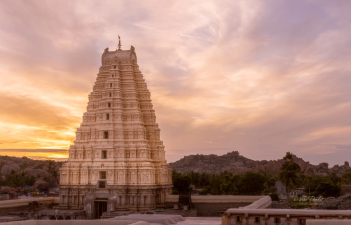
The Archaeological Survey of India (ASI) recently removed modern concrete partitions from the Bistappa Gopuram of the Virupaksha Temple in Hampi, Karnataka. These structures, previously used as administrative offices, had blocked an ancient mantapa (pillared hall). The restoration restores the original architectural layout and ensures the site serves its traditional purpose as a resting place for pilgrims.
Architectural Highlights
- Vijayanagara Style: The temple showcases a fusion of Chalukya, Hoysala, Pandya, and Chola architectural elements.
- Key Features: Includes the Ranga Mantapa (added by Krishnadevaraya in 1510 CE), Kalyana Mantapa for ceremonial rituals, and the Pampa Tirtha connected by underground channels.
- Engineering: Features iconic Yali pillars (mythical beast carvings) and Pushpapotikas (lotus-bud corbels) designed to support heavy stone beams.
- Bistappa Gopuram: A 50-meter, nine-tiered structure; the lower levels are solid granite, while upper tiers utilize brick and stucco.
Conservation Methodology
- Selective Demolition: Hand tools were employed instead of heavy machinery to avoid structural vibrations.
- Lime Mortar: Traditional lime-mortar mixes were used for structural gaps to ensure breathability and prevent moisture entrapment, matching the original medieval composition.
IASPOINT Booster Facts
- UNESCO Status: Hampi was designated a World Heritage Site in 1986.
- Inverted Shadow: The main gopuram exhibits an engineering phenomenon where sunlight projects an inverted shadow of the tower onto the inner courtyard wall.
- Historical Significance: Hampi is identified as Pampa-Kshetra, named after Pampa (daughter of Brahma).
- ASI: Founded in 1861 by Alexander Cunningham; it operates under the Ministry of Culture and enforces the AMASR Act, 1958.