
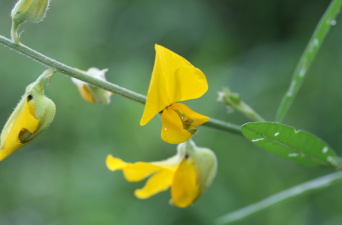
Indian botanists discovered a new species of flowering plant, Crotalaria phulei, in the Khairi-Umred forest range near Nagpur, Maharashtra. Belonging to the legume family Fabaceae, this plant honors Savitribai Phule, a pioneer of women’s education and social reform in India. This is the first plant species ever named after her. The formal description of the species was published in the international taxonomic journal Phytotaxa. Because researchers found only a small population confined to a specific habitat, the species has been provisionally assessed as Data Deficient under the International Union for Conservation of Nature (IUCN) criteria, stressing the need for focused habitat conservation in Central India.
Botanical Classification and Morphological Profile
The genus Crotalaria comprises over 700 species of flowering plants globally, with a large concentration found in tropical and subtropical regions.
Structural Features
- Crotalaria phulei grows as an erect, branched annual herb.
- It features distinct yellow flowers that exhibit a standard papilionaceous (butterfly-like) structure typical of the legume family.
- The plant is distinguished from close relatives by its specific hairiness on the stems, leaf shape, and unique seed pod morphology.
- It bears small, inflated pods containing multiple seeds that rattle when dry, a universal trait of this genus.
Habitat and Distribution
The species was located within the tropical dry deciduous forests of the Khairi-Umred region near Nagpur. It thrives in open, sunny patches among rocky outcrops and thin soil layers that collect during the monsoon season. Currently, its known distribution is restricted entirely to this specific micro-habitat within Central India.
Taxonomic Methodology
Botanists relied on a comparative analysis to confirm the plant as a distinct species.
| Parameter | Application for Crotalaria phulei |
| Family | Fabaceae (Leguminosae) |
| Subfamily | Faboideae |
| Morphological Comparison | Evaluation of stipules, bracts, and floral parts against existing herbarium specimens of the genus Crotalaria. |
| IUCN Status Assessment | Preliminary categorized as Data Deficient (DD) due to a lack of geographic and population trend data. |
| Geographic Coordinates | Documented within the Vidarbha region of Maharashtra, Central India. |
Conservation Concerns and Threats
The localized distribution of Crotalaria phulei makes it vulnerable to environmental changes.
Anthropogenic Pressures
The Khairi-Umred forest area faces threats from livestock grazing, forest fires, and land clearing for agricultural expansion. Because the plant grows outside protected national parks, its habitat is prone to degradation from human activity.
Climate Sensitivity
Being an annual herb, the life cycle of the plant depends on the timing and quantity of the Southwest monsoon. Shifting rainfall patterns in Central India can disrupt seed germination and flowering cycles, threatening the long-term survival of the wild population.
IASPOINT Booster Facts for UPSC
- The “Rattlepods”: The genus name Crotalaria comes from the Greek word Krotalon, which means a castanet or rattle. This refers to the sound the dry seeds make inside the mature pod when shaken.
- Savitribai Phule: Born in 1831 in Maharashtra, she is widely regarded as India’s first female teacher. Along with her husband Jyotirao Phule, she opened the first school for girls at Bhide Wada in Pune in 1848 and worked to eliminate caste and gender discrimination.
- Fabaceae Family Characteristics: This family is economically important because it includes pulses, peas, and beans. Plants in this family possess root nodules containing symbiotic Rhizobium bacteria, which fix atmospheric nitrogen to enrich soil fertility.
- Data Deficient (DD) Category: Under IUCN Red List guidelines, a species is Data Deficient when there is inadequate information to make a direct or indirect assessment of its risk of extinction based on its distribution or population status. It is not a category of threat, but it indicates that more research is required.
- The Flora of Central India: The Deccan peninsula and the Central Indian Highlands serve as a major biogeographic zone. It contains high floral endemism, meaning many species found here grow nowhere else in the world.
