
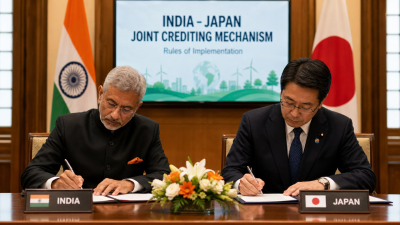
India and Japan adopted the Rules of Implementation for the Joint Crediting Mechanism (JCM) on 8 June 2026 under Article 6.2 of the Paris Agreement; India’s Ministry of Environment, Forest and Climate Change confirmed adoption on 16 June 2026.
Objectives and Legal Basis
- Purpose: Facilitate cooperative mitigation activities that yield tradable carbon credits and support sustainable development.
- Legal basis: Article 6.2 of the Paris Agreement — cooperative approaches involving internationally transferred mitigation outcomes.
- Precedent: Adoption follows a bilateral Memorandum of Cooperation establishing the JCM framework.
Key Components
- Rules of Implementation: Define project eligibility, credit issuance, and benefit‑sharing between the two countries.
- Project scope: Mitigation activities that reduce or remove greenhouse gases and enable low‑carbon technology deployment.
- Sustainable development safeguards: Criteria to ensure projects meet host‑country environmental and social standards.
Governance & Procedures
- Joint Committee: Bilateral body for oversight, project approval and rule interpretation.
- Validation & verification: Third‑party validation and periodic verification required for credit issuance.
- National registries: Host and partner registries to record, track and transfer JCM credits.
Carbon Credits, NDCs & Finance
- Credit sharing: JCM credits can be allocated between India and Japan to assist achievement of respective NDCs.
- Finance & technology: Japanese investment and technology transfer expected to fund and deploy low‑carbon projects in India.
IASPOINT Booster Facts
- Accounting: Article 6 cooperative approaches require robust accounting and tracking to avoid double counting of mitigation outcomes.
- Registry function: National registries record issuance, transfer and retirement of internationally transferred mitigation outcomes.
- Validation standard: Use of independent third‑party auditors aligns with international carbon market practice for integrity.