
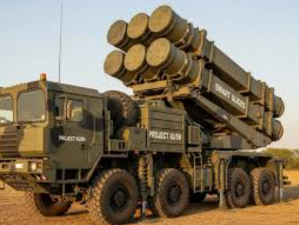
Defence Minister Rajnath Singh highlighted the indigenous Project Kusha as a game changer for national security, noting its successful performance during Operation Sindoor. Developed by the Defence Research and Development Organisation (DRDO), this long-range air defence system is engineered to secure airspace against complex, multi-vector aerial threats. The initiative anchors a broader national plan to build an expansive, network-centric security umbrella that guarantees military self-reliance and strategic autonomy.
Institutional Framework and Strategic Vision
Architectural Integration
Project Kusha, officially classified as the Extended Range Air Defence System (ERADS), marks India’s transition toward independent development of advanced tier-one weapon networks. This surface-to-air missile (SAM) configuration functions alongside existing air defence systems to handle high-altitude and long-range threat interceptions. It is designed to track and neutralise stealth fighter platforms, unmanned aerial vehicles (UAVs), cruise missiles, and precise guided munitions.
Mission Sudarshan Chakra Alignment
The integration of Project Kusha serves as the structural backbone of Mission Sudarshan Chakra, a comprehensive national initiative introduced by Prime Minister Narendra Modi. This umbrella program aims to deploy an interlocked, nationwide multi-tiered missile shield by 2035. The mission coordinates real-time data from ground sensors, airborne platforms, and space-based assets to shield the civilian population, administrative nodes, and vital infrastructure installations.
Technical Specifications and Operational Layers
Three-Tier Interceptor System
The system utilizes three distinct variants of interceptor missiles to achieve deep operational depth. This multi-layered approach balances engagement cost and tracking precision across varying combat distances.
| Interceptor Variant | Operational Range | Targeted Aerial Threats |
| Kusha-M1 | 150 km | Fighter jets, rotary aircraft, tactical surveillance drones. |
| Kusha-M2 | 250 km | Stand-off weapons, cruise missiles, mid-range loitering munitions. |
| Kusha-M3 | 350–400 km | Ballistic missiles, stealth aircraft, heavy strategic bombers. |
Network-Centric Command Grid
A cornerstone of Project Kusha is its full compatibility with the Indian Air Force’s Integrated Air Command and Control System (IACCS). Automated command nodes use big data processing to handle immediate threat prioritization. Bharat Electronics Limited (BEL) acts as the principal industrial partner, leading the integration of modern long-range fire control and surveillance radars.
Changing Dynamics of Modern Air Defence
Technological Adaptation
Modern battlefields present complex challenges like swarm drone saturation and precision-strike networks. Project Kusha addresses these by deploying high-mobility launchers and electronic warfare countermeasures to counter jamming or detection.
Focus on Self-Reliance
By replacing reliance on foreign equipment with indigenous manufacturing networks, India secures long-term lifecycle control over critical parts. This prevents vulnerability to international export controls or supply chain delays during active security situations.
IASPOINT Booster Facts for UPSC
- Mythological Reference: Defence Minister Rajnath Singh compared Project Kusha to the Govardhan Hill, referencing its role as a protective shield covering entire operational regions.
- Operation Sindoor Core: Operation Sindoor was a joint tri-services military campaign launched following the Pahalgam security incident.
- Joint Parliamentary Oversight: The legislative framework for the acquisition of these platforms is under evaluation by a 39-member Joint Parliamentary Committee chaired by PP Chaudhary.
- Local Production Cost: The projected development budget for Project Kusha stands at approximately ₹21,700 crore, targeting active squadron induction within the 2028–2030 timeframe.
- Global Systems Comparison: The interception reach of the Kusha-M3 variant places its capabilities on par with global long-range networks such as the Russian S-400 Triumf and American MIM-104 Patriot.
