
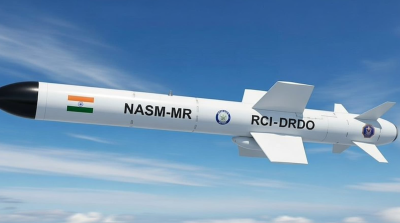
The Defence Research and Development Organisation (DRDO) successfully executed multiple military technology trials from the Integrated Test Range (ITR) off the Odisha coast. The exercises featured the maiden flight test of the indigenous Naval Anti-Ship Missile-Medium Range (NASM-MR) alongside twin interceptions by a multi-layered Ballistic Missile Defence (BMD) system. This validation demonstrates the capacity to neutralize multi-vector maritime and long-range ballistic threats, placing India within a selective tier of nations possessing advanced strategic interception systems. Defence Minister Rajnath Singh commended the milestone for enhancing national deterrence capabilities.
Overview of the NASM-MR Framework
Technical Architecture and Design
The NASM-MR is an all-weather, over-the-horizon, subsonic anti-ship cruise missile engineered to protect maritime frontiers against small to medium surface combatants, including corvettes, frigates, and destroyers. It forms the core of India’s lightweight surface-to-surface and air-launched maritime strike inventory, stepping in to replace older foreign systems like the Boeing Harpoon and Sea Eagle.
Propulsion and Aerodynamics
The missile utilizes a scaled-down derivative of the Manik Small Turbofan Engine (STFE), developed by the Gas Turbine Research Establishment (GTRE), for sustained fuel-efficient cruise propulsion. Initial launch acceleration is delivered by an attachable solid-propellant rocket booster, which detaches post-ignition. The structural design features foldable wings to allow streamlined integration with modern carrier-borne fighter aircraft wings and internal shipboard deployment cells.
Technical Specifications of the NASM Family
The indigenous naval anti-ship missile family covers varying tactical operational limits, reducing strategic dependence on foreign manufacturing ecosystems.
| Metric | NASM-Short Range (NASM-SR) | NASM-Medium Range (NASM-MR) |
| Total Launch Mass | 380 kg | 600–750 kg |
| Max Operational Range | 55 km | 350 km |
| Maximum Cruise Speed | Mach 0.8 | Mach 0.9 |
| Warhead Specification | 100 kg Piercing Cavity Blast (PCB) | 150 kg High-Explosive Multi-EFP |
| Primary Propulsion Type | Solid-fuel booster and sustainer | Solid booster + Turbofan engine |
| Launch Platforms | Sea King, MH-60R, HAL Dhruv | HAL Tejas, MiG-29K, Warships, Submarines |
Guidance and Tracking Systems
- Mid-Course Flight Phase: Driven by an indigenous Inertial Navigation System (INS) combined with satellite guidance updates, an altimeter, and a two-way datalink network for real-time tracking coordination.
- Terminal Attack Phase: Transitions into high-resolution targeting using an advanced seeker network. It operates along low-altitude, sea-skimming trajectories just 5 to 10 meters above the water surface to evade enemy radar detection and shipborne air defense networks.
Ballistic Missile Defence System Upgrades
Phase-II BMD Interceptor Trials
The simultaneous trials validated the advanced Phase-II multi-layered BMD network using next-generation AD-1 and AD-2 interceptor missiles. The exercise simulated real-world threat matrices by tracking and destroying incoming Agni-class target missiles representing hostile threats.
Endo and Exo-Atmospheric Layers
- AD-1 Interceptor (Endo-Atmospheric): Designed for terminal-phase interceptions inside the Earth’s atmosphere. It employs a two-stage solid motor configuration guided by automated algorithms to destroy fast-moving missiles and low-altitude aircraft.
- AD-2 Interceptor (Exo-Atmospheric): Optimized to track and hit mid-course targets at higher altitudes in space, long before re-entry into the atmosphere.
- Velocity Limits: Both interceptor platforms operate within the hypersonic speed regime of Mach 6 to Mach 7, providing defense capabilities against Long-Range and Intercontinental Ballistic Missiles (ICBMs).
IASPOINT Booster Facts for UPSC
- Developer Laboratories: The project is a combined effort of specialized DRDO centers, including Research Centre Imarat (RCI), Defence Research and Development Laboratory (DRDL), and High Energy Materials Research Laboratory (HEMRL).
- The Production Network: Manufacturing is managed via Development-cum-Production Partners (DcPP) utilizing domestic MSMEs and private aerospace networks, reflecting self-reliance mandates.
- Man-in-the-Loop Feature: Demonstrated in the short-range variant, this design allows real-time flight retargeting. Pilots can switch target profiles mid-flight using live feedback from the seeker.
- Strategic Elite Tier: The successful interception of long-range ballistic targets places India alongside the United States, Russia, and China in possessing operational multi-tiered exo and endo-atmospheric defensive frameworks.
- Safety Mandates during Trials: For the execution of these back-to-back tests, local administrations relocated over 11,000 residents from ten villages near Launch Complex-III of the ITR to temporary safety centers under Ministry of Defence protocols.
