
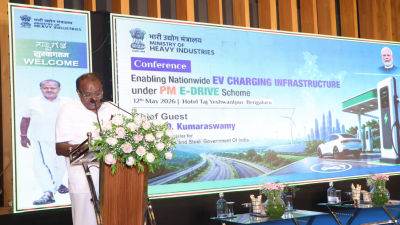
The Union Ministry of Heavy Industries introduced a major digital and physical expansion of India’s electric vehicle ecosystem at the National EV Charging Conference in Bengaluru on 11 and 12 May 2026. Central to this development is the rollout of the Bharat e-Charge platform, officially designated as the National Unified Electric Vehicle Charging Application. Operating as a public digital infrastructure asset, the platform aggregates fragmented public and private charging grids into a single user interface. Concurrently, the government approved capital deployment under the PM E-DRIVE scheme to set up thousands of new charging stations, addressing critical range anxieties across urban and highway corridors.
Architecture of the Bharat e-Charge Platform
The National Unified Electric Vehicle Charging Application functions as an open-access aggregator designed to resolve fragmentation across local charging networks.
Open Interoperability Protocols
The software architecture relies entirely on the open Beckn Protocol and standard Open Charge Point Interface (OCPI 2.2.1/UEI) mechanisms. This technical setup allows different systems to communicate, meaning any compliant charger, operator, or front-end mobile application can exchange real-time operational data. This prevents drivers from needing multiple operator-specific digital accounts.
Nodal Industrial Development
Bharat Heavy Electricals Limited (BHEL) serves as the lead technical entity executing the application software. The structural monetary settlements, processing, and transactional verification layers are managed through the financial network of the National Payments Corporation of India (NPCI).
Corporate Network Integration
Automobile manufacturers and public sector oil marketing companies are linking their proprietary charging assets directly to the application registry. Primary commercial participants include:
- Maruti Suzuki
- Tata Motors
- Indian Oil Corporation Limited (IOCL)
- Bharat Petroleum Corporation Limited (BPCL)
- Hindustan Petroleum Corporation Limited (HPCL)
Real-Time Telemetry and Utility
The user interface provides live updates regarding charger operational status, connector type compatibility, current energy pricing, queue lengths, and precise geographic tracking. Users can discover assets, book physical charging slots, and clear dynamic tariffs within a singular application interface.
Capital Allocation under PM E-DRIVE Scheme
The physical deployment of fast and slow charging points is anchored by fiscal allocations under the flagship PM Electric Drive Revolution in Innovative Vehicle Enhancement (PM E-DRIVE) scheme.
Financial Outlay and Targets
The program reserves a specific budget of ₹2,000 crore out of its total multi-crore mandate purely to expand public electric vehicle supply equipment (EVSE). The broad objective dictates the implementation of approximately 72,000 public charging units nationwide. The planned structural breakdown comprises:
- 22,100 fast chargers optimized for electric four-wheelers (e-4Ws)
- 1,800 dedicated high-capacity chargers for electric buses
- 48,400 charging stations suited for electric two-wheelers (e-2Ws) and three-wheelers (e-3Ws)
Phase-I Sanctions and Regional Distribution
The government approved specialized project proposals worth ₹503.86 crore to fund the immediate installation of 4,874 public chargers. The structural rollout is heavily focused on key growth states:
| State Beneficiary | Charger Allotment Share | Primary Executive Entities |
| Karnataka | Highest allocation (Exceeding 1,000 chargers) | State Discoms & OMC joint ventures |
| Other Major States | Distributed remainder (3,800+ units) across Gujarat, Tamil Nadu, Telangana, Kerala, Rajasthan, Uttar Pradesh, and Andhra Pradesh | HPCL, IOCL, BPCL, and respective state energy corporations |
Strategic Dimensions of Unified Charging Grids
Transitioning toward open, digitized public infrastructure offers distinct economic and logistical benefits for urban governance.
Mitigation of Range Anxiety
Providing reliable, real-time visibility of active charging assets reduces consumer uncertainty. This transparency helps shift electric mobility from early adopters into a mass-market retail phase, particularly for the sensitive passenger vehicle segment where intra-city and inter-city connectivity demands high charger density.
Asset Utilization Optimization
Fragmented networks lower corporate utilization rates because users are kept within closed private apps. A unified discovery layer makes every station visible to every vehicle brand, improving the financial viability of charge point operators (CPOs).
Macroeconomic Implication
Accelerating localized charging accessibility supports the national goal of lowering crude oil import reliance, where India presently imports over 85% of its raw fossil fuel consumption. This shift shields the domestic economy from volatile external energy shocks.
IASPOINT Booster Facts for UPSC
- Nodal Administrative Ministry: The deployment of the PM E-DRIVE scheme and the associated Bharat e-Charge platform is managed directly by the Ministry of Heavy Industries (MHI).
- Precursor Programs: The current framework replaces the older Faster Adoption and Manufacturing of Electric Vehicles (FAME-II) scheme, which concluded its primary execution timeline after funding 8,932 public chargers.
- Subsidy Structure under PM E-DRIVE: The scheme provides up to a 100% financial subsidy for upstream grid infrastructure (transformers, low/high-voltage cabling, circuit breakers) in public-access setups like government institutions, hospitals, and schools. It offers an 80% upstream subsidy and 70% EVSE hardware subsidy at high-density commercial hubs like airports, metro stations, and toll plazas.
- Geographic Targeting Rules: Funding priority targets cities with populations exceeding 1 million (per Census 2011), designated Smart Cities, NCAP (National Clean Air Programme) non-attainment municipalities, and critical satellite towns linked to major metros.
- Standardized Charging Connector: Unlike Western regions that managed multiple conflicting plug standards (CCS1, NACS, CHAdeMO), India standardized its public infrastructure primarily around the Combined Charging System 2 (CCS2) protocol for four-wheelers.
- Unlicensed Activity Status: The Ministry of Power mandates that setting up a public electric vehicle charging station is an unlicensed commercial activity. Any private or public entity can establish an EVSE station provided they adhere to prescribed grid safety and technical connectivity guidelines.