
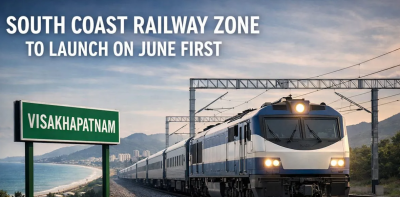
The South Coast Railway Zone (SCoR), functioning as the 18th railway zone of Indian Railways, will commence operations on 1 June 2026 with its headquarters located in Visakhapatnam, Andhra Pradesh. The Union Cabinet approved the creation of this new zonal railway on 7 February 2025 under sub-section (4) of Section 3 of the Railways Act, 1989. The formal Gazette Notification issued by the Ministry of Railways sets the operational date for June 2026, fulfilling a key long-standing administrative commitment linked to the Andhra Pradesh Reorganisation Act. The central government allocated ₹184 crore for setting up the zonal infrastructure, and the foundation stone for the permanent headquarters was laid by Prime Minister Narendra Modi in January 2025.
Structural Reorganisation and Jurisdictional Blueprint
The creation of the South Coast Railway Zone requires a major geographical and administrative restructuring of the existing East Coast Railway (ECoR) and South Central Railway (SCR) zones.
Divisional Composition of SCoR
The new zone brings together four key operational divisions covering parts of Andhra Pradesh, Telangana, Karnataka, and Tamil Nadu:
- Vijayawada Division: Transferred from the South Central Railway zone.
- Guntur Division: Transferred from the South Central Railway zone.
- Guntakal Division: Transferred from the South Central Railway zone.
- Visakhapatnam Division: A newly constituted division carved out from the bifurcation of the legacy Waltair division.
Bifurcation of the Waltair Division
The 133-year-old Waltair railway division, established originally in 1893, is completely dissolved to eliminate colonial-era nomenclature and streamline regional operations:
- The Visakhapatnam Line: A 463-kilometer stretch forms the truncated Visakhapatnam division under SCoR. This jurisdiction contains critical lines such as the Duvvada-Visakhapatnam-Palasa main line, Vizianagaram-Kuneru section, and the industrial lines serving the Visakhapatnam Steel Plant and local ports.
- The Rayagada Line: The remaining 696-kilometer stretch of the old Waltair division is organized into the newly created Rayagada division. This division will remain under the administration of the East Coast Railway, which is headquartered in Bhubaneswar, Odisha.
Inter-Divisional Boundary Realignments
To optimize operational fluidity, the Ministry of Railways altered several specific section boundaries effective 1 June 2026:
- Palasa–Ichchapuram Section: A 53-kilometer track section is transferred from the Khurda Road Division (ECoR) to the Visakhapatnam Division (SCoR).
- Kondapalli–Motumari Section: Shifted from the Secunderabad Division to the Vijayawada Division.
- Pagidipalli–Vishnupuram Line: Transferred from the Guntur Division to the Secunderabad Division (SCR).
- Raichur–Wadi Section: Transferred out from the Guntakal Division into the Secunderabad Division (SCR).
- Fixed Zonal Borders: The Singapore Road–Vizianagaram section serves as the new physical boundary point between the Rayagada and Visakhapatnam divisions.
Infrastructure and Technical Assets
The South Coast Railway Zone inherits a fully modernised rail network with comprehensive technical support facilities across its four divisions.
| Asset Type | Technical Infrastructure Details |
| Track Electrification | 100 percent electrified network operating on 25 kV 50 Hz AC traction |
| Total Route Length | Approximately 3,496 route kilometers |
| Locomotive Sheds | Electric and Diesel Loco Sheds at Visakhapatnam; Electric Loco Shed at Vijayawada; Diesel Loco Sheds at Guntakal and Gooty |
| Passenger Coach Depots | Functional maintenance care centers at Visakhapatnam, Kakinada, Narsapur, Machilipatnam, Vijayawada, Nallapadu, Guntur, and Tirupati |
| Industrial Wagon Depots | Dedicated freight wagon maintenance yards at Vijayawada, Visakhapatnam, and Gooty |
| Technical Training Centers | Specialized railway technique training institutes operating at Vijayawada and Guntakal |
| Divisional Healthcare Centers | Indian Railways employee hospitals located at Visakhapatnam, Vijayawada, Guntakal, Guntur, and Rayanapadu |
Socio-Economic and Logistics Impact
The decentralization of railway administration to Visakhapatnam provides immediate logistics and infrastructure advantages to the eastern and southern transit corridors.
Port Logistics and Freight Acceleration
Visakhapatnam handles heavy freight traffic bound for major national public sector undertakings, including the Visakhapatnam Port Trust, Rashtriya Ispat Nigam Limited (RINL), Indian Oil Corporation (IOC), and Hindustan Petroleum Corporation Limited (HPCL). Localizing the decision-making process under a dedicated zonal headquarters cuts administrative delays for freight clearance, assisting the movement of coal, iron ore, and steel from neighboring mineral belts to deep-water ports.
Passenger Service Enhancements
The operational status of SCoR expedites the modernizing of regional stations under the Amrit Bharat Station Scheme. The zone manages high-density passenger routes supporting tourist and religious hubs like Tirupati. It oversees the operation of 16 Vande Bharat and 22 Amrit Bharat train services across its jurisdictions.
IASPOINT Booster Facts for UPSC
- Temporary Headquarters: Pending completion of the permanent complex, the initial operations of the SCoR zone are managed from a temporary office space at the Visakhapatnam Metropolitan Region Development Authority (VMRDA) complex, known as “The Deck” in Siripuram.
- Zone Number 18: SCoR is officially the 18th independent railway zone in India. The 17th zone was Metro Railway, Kolkata, designated in 2010.
- First General Manager: Senior railway official Sandeep Mathur was appointed to oversee the transition and take charge as the initial General Manager of SCoR.
- The Pit Line Strength: SCoR begins operations with a massive technical layout of 29 operational pit lines used for passenger train washing and safety testing, with the highest concentration in Vijayawada (7) and Visakhapatnam (6).
- Legal Provisions: The structural changes to the zones were executed by exercising central powers under the Railways Act, 1989, superseding previous territorial divisions defined under older British-era railway statutes.