
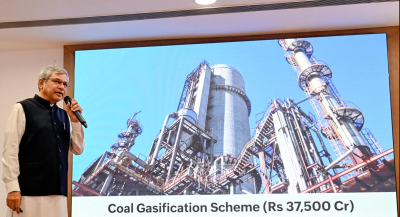
The Union Cabinet approved a ₹37,500 crore financial incentive package to accelerate surface coal and lignite gasification projects across the country. This fiscal intervention aligns with the National Coal Gasification Mission’s target to gasify 100 million tonnes (MT) of coal by 2030, reducing dependence on volatile global energy markets. The program targets the conversion of approximately 75 MT of domestic coal and lignite into synthetic gas, providing raw material for manufacturing urea, methanol, and synthetic natural gas. This policy seeks to insulate the domestic economy from supply chain shocks by capitalizing on large solid fuel reserves.
Technical and Processing Framework
Surface coal gasification converts solid coal into a clean, gaseous fuel through a thermochemical process rather than direct combustion.
Chemical Reagents and Gasification Process
Inside a pressurized industrial reactor known as a gasifier, crushed coal is subjected to temperatures ranging between 1,000°C and 1,400°C. Instead of burning in open air, the coal reacts under controlled conditions with a precise mixture of steam and oxygen. This thermo-chemical breakdown converts the carbon-rich feedstock into synthesis gas, or syngas.
Composition and Downstream Applications of Syngas
Syngas is primarily a mixture of Carbon Monoxide (CO) and Hydrogen (H2). It serves as an essential basic building block for several critical downstream industrial applications:
- Chemical Production: Used to synthesize methanol, dimethyl ether (DME), and ammonium nitrate.
- Agricultural Inputs: Serves as a vital feedstock for manufacturing ammonia and nitrogenous fertilizers like urea.
- Energy Alternatives: Processed via methanation reactors to yield Synthetic Natural Gas (SNG), a direct substitute for Liquefied Natural Gas (LNG).
- Clean Hydrogen: Subjected to a water-gas shift reaction (CO + H2O → CO2 + H2) to separate and harvest industrial-grade hydrogen.
Financial Outlay and Incentive Architecture
The Ministry of Coal administers the fiscal deployment through a competitive and transparent bidding mechanism.
Subsidy Distribution Framework
The government provides financial incentives capped at a maximum of 20% of the total cost of plant and machinery. To ensure commercial execution, the state disburses the subsidy in four equal installments, with each release directly linked to the physical completion of specified project milestones.
Categorized Fiscal Ceilings
The implementation framework enforces strict financial caps to distribute resources evenly across market players:
| Parameter Basis | Maximum Fiscal Incentive Cap (₹) | Exclusions / Conditions |
| Single Project Cap | 5,000 crore | Applies to an individual production facility. |
| Product Category Cap | 9,000 crore | Excludes projects manufacturing Synthetic Natural Gas and Urea. |
| Entity Group Cap | 12,000 crore | Maximum cumulative support allowed for a single corporate group. |
Macroeconomic Rationale and Strategic Imperatives
India maintains the world’s fifth-largest coal reserves, yet remains exposed to substantial trade deficits due to hydro-carbon imports.
Domestic Resource Profile
The domestic geological base includes approximately 401 billion tonnes of coal and nearly 47 billion tonnes of lignite. Lignite represents a younger, lower-rank variety of coal characterized by lower carbon content and higher moisture levels than bituminous coal. Currently, solid mineral fuels drive more than 55% of the total domestic primary energy mix.
Import Substitution Potential
In the 2025 financial year, India’s aggregate import bill for substitutable fossil fuels and chemical inputs reached ₹2.77 lakh crore. Geopolitical friction in West Asia emphasizes the need for domestic alternatives. The current import vulnerabilities span multiple segments:
- Ammonia: 100% dependency on foreign suppliers.
- Methanol: 80% to 90% supplied through external trade channels.
- Liquefied Natural Gas (LNG): Greater than 50% import reliance for industrial and domestic consumption.
- Urea: Approximately 20% of domestic agricultural demand met via imports.
Projected Socio-Economic Capital Returns
The ₹37,500 crore financial package functions as a core fund intended to pull in ₹2.5 lakh crore to ₹3 lakh crore in private and public sector investments. The construction and operationalization of roughly 25 targeted gasification plants are projected to create 50,000 direct and indirect jobs within India’s coal-bearing regions. Furthermore, the targeted 75 MT gasification rate is estimated to yield ₹6,300 crore in annual non-tax mining revenues to the state, supplemented by downstream Goods and Services Tax (GST) collections.
Policy Extensions and Structural Reforms
To attract long-term private capital into a highly capital-intensive sector, the government introduced complementary regulatory adjustments.
Long-Term Fuel Security
The policy extends the official coal and lignite linkage tenure up to 30 years for syngas-producing projects. This adjustment operates under the “Production of Syngas leading to Coal Gasification” sub-sector within the Non-Regulated Sector (NRS) linkage auction framework, providing fuel supply guarantees over the lifespan of the plant.
Programmatic Continuity
The 2026 scheme expands upon the foundational National Coal Gasification Mission launched in 2021. It scales up the financial architecture established under an earlier ₹8,500 crore incentive scheme approved in January 2024, under which eight commercial projects involving an investment of ₹6,233 crore are actively under implementation.
Key Challenges in Implementation
- High Ash Content: Indian coal typically contains more than 40% ash, whereas global gasification technologies are designed for low-ash coal containing less than 25% ash. High ash causes slagging, which can melt and clog reactors.
- Technology Deficit: India lacks commercial-scale, mature indigenous gasification plants, causing a heavy reliance on foreign engineering, procurement, and construction (EPC) contractors.
- Carbon Emissions: The transformation process remains carbon-intensive. Achieving net-zero goals by 2070 requires integrating Carbon Capture, Utilization, and Storage (CCUS) systems, which adds capital costs and technical complexity.
IASPOINT Booster Facts for UPSC
- Nodal Ministry: The Ministry of Coal acts as the administrative authority supervising both the National Coal Gasification Mission and the newly sanctioned incentive scheme.
- Technology Status: The scheme is entirely technology-agnostic. While foreign designs are permitted, it prioritizes the development of indigenous systems like Pressurized Fluidized Bed Gasification (PFBG) optimized for high-ash domestic coal.
- Ancillary Benefits: Gasification removes sulfur dioxide (SO2), nitrogen oxides (NOx), and particulate matter during the synthesis phase, making its local emissions profile lower than conventional thermal power generation.
- Incentive Interaction: The fiscal benefits provided under this gasification scheme are additive. They do not restrict participating entities from claiming separate financial incentives under the commercial coal mining liberalized regime or alternative state-level industrial policies.