
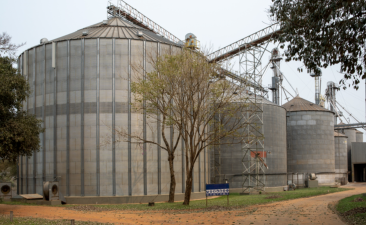
The World’s Largest Grain Storage Plan in the cooperative sector is being implemented to expand storage capacity at the Primary Agricultural Credit Societies (PACS) level and strengthen the agricultural marketing chain. The initiative uses convergence of existing government schemes, cooperative lending institutions, and subsidy support to create decentralised grain storage infrastructure across suitable locations.
Selection of PACS
- PACS must be identified and approved through District Cooperative Development Committees.
- Selection is done in locations identified by agencies such as FCI, NAFED and NCCF.
- The location must show storage demand or a storage gap and must be suitable for hiring assurance by the agencies.
- The PACS should have positive net worth in the last two financial years.
- The PACS should not be a bank defaulter and should have been profitable for the last three consecutive financial years.
- The cumulative profit in the last three years should preferably exceed ₹5 lakh.
- The proposed godown should preferably have a minimum storage capacity of 500 MT.
Scheme Convergence
- The plan is implemented through convergence of schemes such as Agriculture Infrastructure Fund, Agricultural Marketing Infrastructure Scheme, Sub Mission on Agricultural Mechanisation and PMFME.
- Under the Agriculture Infrastructure Fund, PACS receive interest subvention on loans taken for godown construction.
- Under the Agricultural Marketing Infrastructure Scheme, 33% subsidy is provided for foodgrain storage construction.
- The model is designed to reduce dependence on a single funding source and improve viability.
Role of Lending and Subsidy Agencies
- NABARD acts as the subsidy channelising agency for projects under the Agricultural Marketing Infrastructure Scheme.
- State Cooperative Banks and District Central Cooperative Banks serve as the primary lending institutions for PACS.
- They sanction and disburse credit in a time-bound manner under the implementation framework.
- NABARD’s special refinance scheme further reduces the financial burden on cooperatives.
Financial Support and Policy Significance
- When combined with the 3% interest subvention under AIF, the effective loan interest rate for PACS is reduced to 1%.
- Some States, including Rajasthan and Gujarat, are also supporting godown construction through their own schemes.
- The plan aims to improve storage access, reduce post-harvest losses and strengthen the cooperative sector’s role in foodgrain management.
- It also supports decentralised procurement and local-level storage infrastructure.