
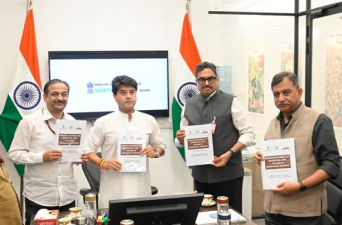
Union Minister for Development of North Eastern Region (MDoNER) Jyotiraditya M. Scindia launched the mission on “Arunachal Kiwi: The USP of Arunachal Pradesh.” This cluster-based kiwi cultivation and value chain development program has an investment outlay of approximately ₹167 crore. The mission aims to address critical gaps in agricultural infrastructure, eliminate distress sales by expanding shelf life, and upgrade the economic landscape for local growers. Positioned under the broader “Brand North East” framework, the scheme seeks to transform the state from a raw fruit supplier into a premium, traceable source of organic kiwi by the financial year 2028.
Core Objectives and Strategic Pillars
The initiative is structured to resolve systematic market failures that currently reduce farmer profits. Although Arunachal Pradesh produces over 50 percent of India’s kiwis, localized structural inefficiencies limit the economic returns for small agriculturalists.
Four Pillars of the Mission
- Convergence: Pooling resources from multiple union ministries, state departments, and financial institutions to remove duplicate administrative efforts.
- Value Addition: Establishing specialized processing centers to convert low-grade produce into secondary consumer goods.
- Branding: Creating a distinct consumer identity for northeastern organic fruits in metropolitan retail sectors.
- Market Integration: Linking regional farmer networks directly with national grocery chains and international logistics networks.
Resolving the Price Realization Disparity
The mission directly targets the revenue gap between local growers and international importers. Currently, domestic farmers receive between ₹20 and ₹40 per kilogram for Grade C kiwis, and roughly ₹120 per kilogram for premium Grade A fruit. In contrast, imported foreign kiwis fetch higher prices in major Indian cities. The expansion of localized grading facilities aims to provide a four-to-six-fold increase in direct value realization for native farming families.
Institutional Framework and Whole-of-Government Integration
The program operates via a combined governance model that coordinates multiple existing central and state-level public development welfare schemes.
Participating Central Ministries and Financial Bodies
- Ministry of Development of North Eastern Region (MDoNER): Acts as the anchor institution managing fund distribution and inter-state bureaucratic clearances.
- Ministry of Agriculture and Farmers Welfare: Delivers technical farming advisories, hybrid cultivars, and primary soil-health inputs.
- Ministry of Rural Development: Integrates the Mahatma Gandhi National Rural Employment Guarantee Scheme (MGNREGS) for ground clearance and orchard boundary constructions.
- National Bank for Agriculture and Rural Development (NABARD): Provides concessional rural credit lines, working capital loans, and tracks financial literacy among farm groups.
Executing Technical Agencies
- ICAR-CITH: The Indian Council of Agricultural Research – Central Institute of Temperate Horticulture provides specialized research support for high-altitude fruit management.
- APEDA: The Agricultural and Processed Food Products Export Development Authority creates export phytosanitary documentation and arranges global buyer-seller meets.
- NERAMAC: The North Eastern Regional Agricultural Marketing Corporation acts as the direct state procurer, handling bulk collection and retail supply chains.
Infrastructure Development and Cluster Management
The program shifts away from fragmented individual farming methods, moving instead toward a coordinated, cluster-based production model.
Integrated Post-Harvest Management Hubs
The scheme establishes six regional post-harvest hubs across the primary kiwi-growing geographic zones of the state. These centers combine sorting lines, automated grading machinery, and washing units in single facilities.
- Ziro Valley (Located within Lower Subansiri district)
- Dirang (Located within West Kameng district)
- Kalaktang (Located within West Kameng district)
- Shi Yomi District Clusters
- Dibang Valley Hubs
Target Outputs and Technical Specifications
The infrastructure upgrades are designed around specific metrics to minimize post-harvest fruit losses.
| Infrastructure Category | Planned Target Metric | Primary Operational Function |
| Cold-Chain Storage | 2,000 Metric Tonnes (MT) capacity | Eliminating the current 7-to-10-day distress-sale window |
| Model Orchards | Distributed across 13 pilot districts | Practical field training for scientific pruning and canopy management |
| Centre of Excellence | Established at Kardo, Ziro | Mass production of disease-free tissue-cultured saplings |
| Traceability Systems | 100% QR-code enabled packaging | Farm-to-fork consumer tracking for single-origin validation |
Export Economics and the Brand North East Matrix
The mission uses a specific harvesting window to build competitive export advantages in global fruit markets.
The Off-Season Export Window
Arunachal Pradesh harvests its main kiwi crop between November and January. This timeframe coincides with the winter off-season in the southern hemisphere, particularly for major exporters like New Zealand. The mission targets this supply gap to position the state’s organic kiwi within South-East Asian, European, and Middle Eastern retail markets.
Brand North East Specialty Architecture
The kiwi program is integrated into a wider central strategy that assigns a distinct agricultural specialty product to each northeastern state.
- Arunachal Pradesh: Organic Kiwi
- Sikkim: Fully Certified Organic Agriculture State
- Mizoram: High-oil Content Ginger
- Tripura: Queen Pineapple
- Nagaland: High-altitude Single-origin Coffee
- Meghalaya: Curcumin-rich Lakadong Turmeric
IASPOINT Booster Facts for UPSC
- The Organic Certification Recovery: The mission focuses on restoring the National Programme for Organic Production (NPOP) organic certification for regional kiwi orchards. Arunachal Pradesh was the first Indian state to secure bulk organic certification for kiwi under the Mission Organic Value Chain Development for North Eastern Region (MOVCD-NER) in 2020.
- Dominant Cultivars: The high-altitude valleys of the state primarily grow the Hayward and Allison cultivars of kiwi (Actinidia deliciosa). These varieties grow well in temperate agro-climatic conditions that feature cool summers and chilly winters.
- Botanical Requirements: Kiwi vines are dioecious, requiring separate male and female plants for fruit production. Successful cultivation relies on a strict orchard planting ratio (typically 1 male plant for every 8 or 9 female vines) and active local honeybee populations for pollination.
- Geographical Advantage of Ziro Valley: The Ziro Valley sits on an old Gondwana rock crust plateau at an elevation of roughly 1,500 to 2,200 meters. The cool climate, well-drained pine-soil slopes, and high UV sunlight levels create the specific sugars and aromatic profiles found in the local fruit.
- King Samprati Links: While historical agricultural records focus on the 20th-century introduction of commercial kiwi to India, tribal oral histories in regions like West Kameng note that ancient high-altitude trade paths across the Eastern Himalayas have long connected regional communities with wild, indigenous varieties of the Actinidia family.