
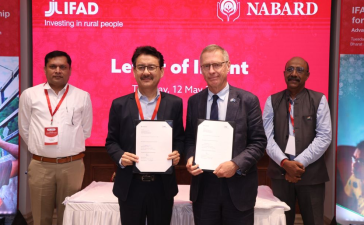
The International Fund for Agricultural Development (IFAD) and the Government of India have finalized a new eight-year cooperation framework under the Country Strategic Opportunities Programme (COSOP) spanning 2026 to 2033. This strategic plan aims to scale up investments, de-risk grassroots innovations, and foster inclusive, climate-resilient agricultural growth across India’s rural ecosystems. The official launch involved extensive high-level consultations between a senior IFAD delegation and central ministries, including Finance, Agriculture and Farmers Welfare, and Rural Development. This framework represents a structural shift from basic poverty alleviation toward creating market-oriented, self-sustaining rural livelihoods that align with the national vision of Viksit Bharat@2047.
Core Pillars of the 2026–2033 Strategy
Institutional Strengthening and Financial Inclusion
The roadmap places grassroots community organizations at the center of its execution strategy. It emphasizes improving credit facilities and formal market linkages by integrating Self-Help Groups (SHGs), Farmer Producer Organizations (FPOs), and primary agricultural cooperatives. A primary objective is turning these local networks into formal commercial entities to improve collective bargaining power and expand credit access, particularly for women-led enterprises.
Climate Resilience and Agricultural Transition
To help smallholders handle erratic weather pattern risks, the program shifts production focus toward climate-smart agriculture. Central targets include increasing self-sufficiency in pulses and oilseeds, maximizing input-use efficiency, and scaling up the cultivation of climate-resilient crops like millets.
Value-Chain Integration and Entrepreneurship
The framework targets integrating rural enterprises into organized value chains. This involves setting up localized processing units, creating cold storage infrastructure, providing branding assistance, and connecting local producers to digital e-commerce platforms. The plan explicitly addresses creating non-farm livelihood opportunities, rural youth entrepreneurship, and skill development.
Institutional Framework and Implementation Partners
| Participating Institution / Ministry | Primary Operational Role |
| Ministry of Finance (Department of Economic Affairs) | Directs project synchronization, handles budget allocation, and oversees bilateral funds management. |
| Ministry of Agriculture and Farmers Welfare | Executes field interventions for input-use efficiency, digital agriculture deployment, and FPO capacity expansion. |
| Ministry of Rural Development | Converges program actions with State Rural Livelihood Missions (SRLMs) and flagship rural employment initiatives. |
| National Bank for Agriculture and Rural Development (NABARD) | Provides refinancing facilities and supports innovations in allied sectors like fisheries and livestock. |
Geographic Focus and Ongoing Projects
The roadmap leverages ongoing models to scale up rural development systems across the country.
Northeast India Interventions
- Meghalaya: The ongoing Meghalaya Livelihoods and Access to Markets Project (Megha-LAMP) serves as a principal framework model. It has successfully improved market access for more than 45,000 rural enterprises by improving community-led supply chains in the Ri-Bhoi district.
- Assam: New initiatives are undergoing planning with the state government to boost total agricultural productivity, improve livestock systems, and upgrade rural infrastructure.
Pan-India Field Operations
- Jammu & Kashmir: Targeted initiatives focus on improving climate resilience and income security for 300,000 small and marginal farmers.
- Maharashtra: Programs prioritize creating direct income-generation opportunities and long-term employability for rural women.
- Uttarakhand: Specialized projects target reversing climate-induced distress migration by generating localized agro-processing livelihoods.
Global Knowledge Exchange and South-South Cooperation
The roadmap positions India as an important source of developmental expertise for the Global South. It establishes a formal framework for South-South and Triangular Cooperation to export successful indigenous models to developing nations across Africa, Southeast Asia, and Latin America. Key areas for international knowledge sharing include:
- Scaling up the large-scale financial inclusion of women using the SHG model.
- Using the JAM (Jan Dhan, Aadhaar, and Mobile) Trinity to directly deliver agricultural credit and rural subsidies.
- Deploying open-source digital agriculture solutions for weather forecasting and crop health monitoring in remote regions.
IASPOINT Booster Facts for UPSC
- About IFAD: Established on December 15, 1977, as an outcome of the 1974 World Food Conference, IFAD functions as a specialized agency of the United Nations. It is the only multilateral development organization focused solely on rural economies and global food security.
- Headquarters: Rome, Italy.
- India’s Membership Status: India is a founding member and belongs to the Category C (Developing Countries) group. It is one of the top contributors to IFAD’s financial resources and serves on its Executive Board.
- Portfolio Magnitude: India represents one of IFAD’s largest operational landscapes globally. Over a 48-year partnership, the collaboration has supported 35 projects with a combined total portfolio value of approximately $4.2 billion.
- High Co-financing Ratio: India maintains an internal co-financing ratio of 2.65, which is much higher than the global average. This demonstrates high domestic funding commitment and active state ownership of the projects.