
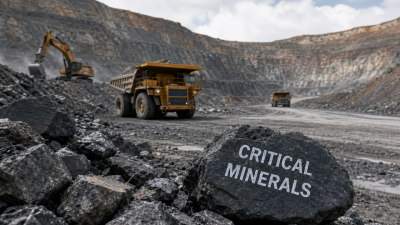
Recently India and Uzbekistan reaffirmed deeper trade and energy cooperation prioritising secure access to critical minerals for India’s expanding digital economy. Uzbekistan opened plans for a digital geological database while a US‑India Critical Minerals Security Taskforce began work on value‑chain collaboration.
What is the issue
Critical minerals — lithium, nickel, cobalt, rare earths and related metals — are essential inputs for data centres, AI infrastructure, batteries and renewable energy equipment. Securing reliable supplies and processing capacity has become a strategic policy priority for India’s economic growth, energy transition and geopolitical autonomy.
Why it matters for governance and strategy
- Economic growth: Reliable critical mineral supply underpins expansion of cloud services, AI, electronics manufacturing and EVs.
- Energy transition: Batteries, permanent magnets and power electronics require specific minerals and processing capacity.
- Strategic autonomy: Concentration of production and processing in a few countries creates geopolitical and trade risks that affect national security and industrial policy.
India’s strategic imperatives for critical minerals
Policy aims cover supply security, value‑chain capture (from extraction to manufacturing), technological capability for processing and reduced dependence on single-country suppliers. Domestic resource development, targeted schemes and external partnerships form a combined approach to achieve supply resilience.
Domestic resource strategy and exploration
Key measures
- Expanded exploration: Focus on eastern and north‑eastern states to map and assess critical mineral deposits.
- Notable deposit signals: Promising lithium occurrences reported in Rajasthan, Chhattisgarh and Jammu & Kashmir; nickel and cobalt finds near Nagaland border areas.
- Timescale estimate: Industry assessments expect sufficient deposits and requisite processing technology within 2–3 years to enter value chains at scale.
Policy and institutional frameworks
- National Critical Minerals Mission: Central umbrella for mapping, exploration incentives, strategic stockpiling and aligning ministries and PSUs.
- Rare Earth Permanent Magnets Scheme: Targeted support to build downstream capacity for magnets used in motors and wind turbines.
- Regulatory measures: Reforms to mining auctions, exploration licensing and incentives for processing and R&D.
International cooperation — Uzbekistan
- Bilateral engagement: During the 14th India‑Uzbekistan Intergovernmental Commission India highlighted critical minerals as a key area for energy cooperation.
- Trade goals: Both sides agreed to deepen trade, address non‑tariff barriers and work toward doubling bilateral trade in three years.
- Supply facilitation: Uzbekistan announced an open digital geological database covering all minerals and plans to expand deposits offered for auction to attract foreign investment into “Metals of the Future” technoparks.
International cooperation — US, Quad and multilateral frameworks
- US‑India Critical Minerals Security Taskforce: Inaugural meeting convened private firms from both countries to draft a roadmap across processing, manufacturing and technology collaboration.
- Framework agreement: The taskforce builds on a formal “Securing Supply in Mining and Processing of Critical Minerals and Rare Earths” framework signed by senior officials; alignment exists with the Quad Critical Minerals Initiative.
- Strategy effect: These partnerships aim to diversify sources, transfer processing technology and mobilise investment into resilient value chains beyond single‑country dominance.
Role of critical minerals in the digital economy and energy transition
- Digital infrastructure: Data centres and AI hardware require high‑performance chips, power electronics and cooling systems whose supply chains depend on specific minerals and magnets.
- Clean baseload power: Scaling renewables and grid stability needs storage and power‑electronics components dependent on battery materials and rare earths.
- Manufacturing link: Localising processing and magnet manufacturing reduces import dependence and supports domestic electronics and EV industries.
Geoeconomic implications and supply‑chain diversification
India is pursuing diversification to reduce dependence on concentrated suppliers. The strategy pairs domestic resource development with partnerships in mineral‑rich states and technology alliances with processing leaders. Bilateral deals, open geological data from partner states and taskforces with advanced economies create alternative sourcing and processing corridors.
Challenges
| Dimension | Constraint |
|---|---|
| Exploration & extraction | High capital intensity, long lead times, complex geology and environmental clearances. |
| Processing technology | Need for specialised metallurgy, separation and refining facilities; limited domestic experience for some minerals. |
| Investment and industry | Large private and foreign capital required across the value chain; risk perceptions and permitting friction. |
| Environmental and social | Land, water and livelihood conflicts; requirement for sustainable mining and community consent mechanisms. |
| Geopolitical risk | Market concentration in a few countries and trade restrictions can disrupt supply. |
Way forward — policy and operational measures
| Action area | Priority measures |
|---|---|
| Accelerate exploration | Scale public geological mapping, fast‑track licensing, fiscal incentives and state‑centre coordination for eastern and north‑eastern regions. |
| Build processing capacity | Support demonstration plants, capital subsidies, technology tie‑ups and clusters for refining and magnet manufacturing under targeted schemes. |
| International partnerships | Formalise supply agreements, joint ventures with mineral exporters (e.g., Uzbekistan), and technology pacts with US/Quad partners. |
| Investment & finance | Use sovereign, multilateral and private finance; incentivise greenfield and brownfield investments into technoparks and processing units. |
| Environmental and social governance | Apply strict environmental standards, community benefit sharing, rehabilitation funds and transparent auction processes. |
| R&D and skills | Fund metallurgy research, recycling technologies and skill development for downstream manufacturing. |
Model Questions
- Analyse India’s multi-pronged strategy for critical mineral security, covering domestic exploration, policy frameworks and international collaboration. Discuss recent engagements with Uzbekistan and the US-India taskforce. [GS-II: International Relations] Answer Hint: Outline domestic measures (exploration in Rajasthan, Chhattisgarh, J&K; nickel/cobalt in Nagaland), National Critical Minerals Mission, Rare Earth Permanent Magnets Scheme; then assess bilateral ties with Uzbekistan (geological database, auctions, trade targets) and the US-India taskforce and Quad alignment for processing, tech transfer and supply diversification.
- Examine how critical minerals support India’s digital economy and energy transition. What are the geoeconomic implications of securing these supplies and reducing dependence on single suppliers? [GS-III: Economic Development] Answer Hint: Explain mineral dependencies for data centres, AI hardware, batteries and magnets; link to clean baseload and EVs. Analyse geoeconomic risks from supplier concentration, trade leverage, and benefits of diversification via domestic capacity, Uzbekistan partnership and US/Quad cooperation for resilient supply chains.
- Evaluate India’s institutional and policy initiatives to enter global critical mineral value chains. What role do bilateral and multilateral frameworks play? [GS-III: Economic Development] Answer Hint: Describe the National Critical Minerals Mission and Rare Earth Permanent Magnets Scheme, regulatory reforms and incentives; assess bilateral deals (Uzbekistan) and frameworks with the US (May framework, taskforce) and Quad as mechanisms for technology, investment and market access to move from raw supply to processed goods.
- Critically assess challenges to India’s critical mineral self-sufficiency and propose a realistic way forward to secure sustainable access by 2029. [GS-III: Economic Development] Answer Hint: Identify constraints (exploration lead times, processing technology gaps, investment needs, environmental concerns, geopolitical concentration). Recommend measures: accelerate mapping and licensing, build processing clusters, secure bilateral offtakes, attract finance, enforce ESG standards, invest in R&D and recycling to achieve resilience within the timeframe.