
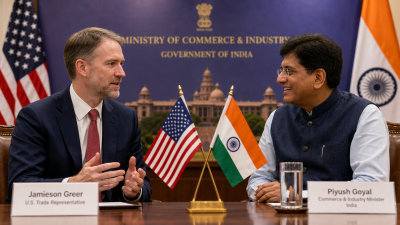
India and US officials are holding high‑level talks in New Delhi to finalise the framework for a first‑phase bilateral trade agreement or interim pact. Discussions aim to resolve tariff architecture before a U.S. tariff reset on 24 July and to manage concurrent Section 301 proceedings and commerce priorities.
Current issue
What is being negotiated
- Objective: Finalise framework for a first‑phase bilateral trade agreement (BTA) / interim pact to set tariffs and market‑access terms.
- Negotiating parties: US Trade Representative Jamieson Greer and Commerce Minister Piyush Goyal, supported by technical teams.
- Immediate calendar constraints: Temporary 10% U.S. tariff expires on 24 July; Section 301 final hearing scheduled for 7 July.
Why it matters
- Economic: Bilateral trade exceeded USD 140 billion (FY 2025‑26). India posted a USD 34.4 billion surplus (exports USD 87.3b; imports USD 52.9b).
- Commercial competitiveness: India seeks tariff advantages versus Vietnam, Bangladesh and ASEAN to defend export markets.
- Strategic: Trade terms will shape India‑US economic alignment in the Indo‑Pacific and influence global supply‑chain relocation.
- Regulatory risk: Section 301 measures and a U.S. Supreme Court ruling have altered previously agreed elements and require re‑appraisal.
Strategic and economic significance of a BTA
- Market access: Lower U.S. tariffs raise price competitiveness for Indian exporters; earlier framework proposed cuts from 50% to 18% on specified lines.
- Investment and technology: Improved market certainty can attract U.S. investment and technology partnerships in manufacturing, energy, defence, and services.
- Supply‑chain diversification: A BTA supports relocation from single‑source suppliers and strengthens India’s role in regional value chains.
- Geopolitical economics: A trade deal complements strategic cooperation within Quad and other Indo‑Pacific initiatives, reinforcing rule‑based trade practices between partners.
Major impediments and contentious issues
| Issue | India’s stance | US stance / constraint | Implication |
|---|---|---|---|
| Tariff levels | Seeks competitive tariff advantage relative to ASEAN rivals; wants steep cuts on U.S. duties on key Indian lines. | US requires reciprocity and domestic legal compliance; earlier reciprocal tariffs were struck down and must be redesigned. | Negotiations must reconcile different baselines and legal limits; tariff parity affects competitiveness of Indian exporters. |
| Section 301 / forced labour | Opposes blanket tariffs; offers supply‑chain transparency measures and compliance cooperation. | Proposes 12.5% tariff pending final hearing; links trade remedies to forced‑labour concerns. | Risk of additional U.S. duties raises uncertainty and could offset tariff concessions from a BTA. |
| Market access for services and agriculture | Willing to cut tariffs on selected U.S. industrial and agricultural goods; careful on sensitive farm sectors. | Seeks greater access for industrial goods, services, and agricultural products; domestic political constraints exist. | Negotiations require product‑by‑product assessment and safeguard mechanisms to protect vulnerable domestic sectors. |
India’s demands and offered concessions
- Primary demand: Competitive tariff advantage that helps Indian exporters compete with Vietnam, Bangladesh and ASEAN suppliers in the U.S. market.
- Concessions proposed: Tariff reductions on selected U.S. industrial and agricultural products; commitment to increase U.S. purchases — an indicative target of USD 500 billion over five years.
- Regulatory offers: Enhanced cooperation on rules of origin, standards alignment, customs facilitation and supply‑chain due diligence.
Impact on India’s export competitiveness
- Direct price effect: Reduction of U.S. tariffs (example proposal: from 50% to 18% on certain lines) would improve margins for exporters in textiles, leather, gems & jewellery and selected industrial goods.
- Sectoral gains: Export growth potential for labour‑intensive sectors and manufactured goods; services and IT likely benefit via ancillary demand.
- Counter‑competition: Tariff preference could neutralise advantages currently held by Vietnam and Bangladesh under their bilateral arrangements.
- Standards and compliance: Integration into U.S. supply chains will require compliance with labour, environmental, and product standards — a compliance cost but long‑term quality premium.
Contribution to Indo‑Pacific economic architecture
- Regional signalling: A BTA would demonstrate India‑US willingness to set trade norms outside exclusive blocs and to deepen economic interdependence in the Indo‑Pacific.
- Supply‑chain anchoring: The pact would support re‑routing of critical value chains to India, increasing regional resilience.
- Institutional alignment: Could lead to closer cooperation on investment screening, digital trade rules and standards that inform broader regional agreements.
Negotiation risks and immediate priorities
- Time pressure: Tariff reset on 24 July compresses decision‑making and increases leverage of interim measures.
- Legal constraints: U.S. domestic legal rulings require redesign of prior reciprocal tariff elements.
- Section 301 outcome: A final U.S. decision on forced‑labour tariffs may impose extra levies on Indian exports if remediation is insufficient.
- Domestic politics: Sensitive Indian farm and manufacturing constituencies will scrutinise concessions; U.S. Congress and interest groups influence final approvals.
Policy levers for India during and after negotiations
- Targeted tariff schedules: Use sectoral lists and phased liberalisation with safeguard clauses and adjustment assistance.
- Standards and compliance: Accelerate supply‑chain due diligence, labour law enforcement, and certification to address forced‑labour concerns.
- Domestic support: Scale PLI schemes, export credit, logistics investments and quality infrastructure to convert tariff gains into sustainable exports.
- Strategic trade diplomacy: Link tariff offers to procurement pledges and investment facilitation to secure mutual benefit and offset political resistance.
Model Questions
1. Evaluate the strategic and economic significance of a comprehensive bilateral trade agreement between India and the United States. [GS-II: International Relations]
A BTA would deepen economic interdependence, raise market access for Indian goods, and attract U.S. investment and technology. Strategically it anchors India within an Indo‑Pacific economic framework and supports supply‑chain diversification. Risks include domestic adjustment costs and legal constraints in the U.S. Effective implementation needs safeguards, investment facilitation, standards alignment and sectoral support for affected producers.
2. Analyse the major impediments and contentious issues currently impacting the India‑US trade negotiations. [GS-III: Economic Development]
Key impediments are divergent tariff expectations, re‑evaluation required after a U.S. Supreme Court ruling, and Section 301 proceedings linked to forced‑labour allegations. Time pressure from a U.S. tariff reset and sensitive domestic sectors in both countries add complexity. Resolution requires legal‑compliant tariff design, targeted concessions, enforceable labour and standards arrangements, and calibrated safeguard mechanisms.
3. Discuss India’s key demands and proposed concessions in the ongoing negotiations and assess their likely impact on India’s export competitiveness. [GS-III: Economic Development]
India demands competitive tariff advantages vis‑à‑vis ASEAN rivals and offers tariff cuts on select U.S. industrial and agricultural goods plus increased U.S. purchases (indicative USD 500 billion target). If realised, tariff cuts would improve price competitiveness for textiles, leather and manufactured exports, strengthen supply‑chain integration, and reduce market share loss to Vietnam/Bangladesh, subject to compliance costs and safeguard arrangements.
4. How do current India‑US trade negotiations contribute to the evolving Indo‑Pacific economic architecture? [GS-II: International Relations]
Negotiations set bilateral norms that can influence regional trade governance, support diversification of supply chains into India, and align standards and investment practices with like‑minded partners. A BTA reinforces economic pillars of strategic groupings, facilitates interoperability on digital and trade rules, and provides a template for resilient, rules‑based commerce in the Indo‑Pacific, subject to multilateral coherence.
Last Modified: June 23, 2026