
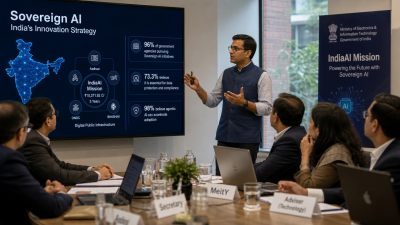
Currently, debate over “sovereign AI” has intensified after US restrictions on access to certain foreign models. Indian agencies are actively pursuing sovereign AI, but large-scale investment remains limited. Policy action (IndiaAI Mission) and Digital Public Infrastructure integration are shaping the government response.
What is sovereign AI and why it matters
Sovereign AI means the ability to develop, control and deploy domestic AI models and infrastructure to reduce reliance on foreign foundational models. It matters for governance, data protection, strategic autonomy, continuity of services under export controls, and for domestic innovation and employment.
Current status and policy response
- Government activity: Nearly all Indian government agencies (96%) are pursuing sovereign AI; 46% are evaluating technologies and 46% run proof-of-concept projects. Only 4% have moved into significant investment.
- Flagship scheme: IndiaAI Mission approved with a budget of ₹10,371.92 crore over five years under MeitY.
- DPI integration: AI regulation and innovation are being integrated into Digital Public Infrastructure—Aadhaar, UPI, ONDC and BHASHINI—to embed governance and data stewardship into deployments.
- Perceptions: 73.3% of government leaders see sovereign AI as necessary for protecting sensitive national data; nearly 98% believe agentic AI can accelerate adoption across the public sector.
Rationale for pursuing sovereign AI
- Data protection: Local control reduces exposure of sensitive government and citizen data to foreign jurisdictions and commercial practices.
- Continuity and autonomy: Export controls or selective access by foreign vendors can disrupt services; an “AI continuity doctrine” is a policy response to that risk.
- Geopolitics: Strategic independence in critical technologies reduces leverage from foreign policy shifts.
- Economic policy: Building domestic capabilities can create high‑value R&D and skilled jobs beyond the current IT services model.
India’s innovation strategy and economic implications
- Current model: Indian firms excel at applying Western AI tech in services but rarely build foundational LLMs themselves.
- Cost and scale: Foundational model development is capital‑ and compute‑intensive. Public funding alone faces scepticism about cost‑effectiveness and crowding out private investment.
- Growth effects: Historical experience with export controls on technologies did not stall India’s IT services growth; selective import facilitation and fiscal reforms can sustain competitiveness.
- Policy levers: Invest in R&D centres at IITs, IISc and NCST; ease imports of specialised equipment; use fiscal tools to encourage risk capital and scale‑up investments.
Key challenges to scaling sovereign AI
- Talent shortage: Over nine in ten government leaders report shortages of specialised digital talent for model development and deployment.
- Funding gap: Only 4% of organisations are in significant investment phases, signalling a funding and prioritisation gap.
- Compute and data: Access to high‑end compute and curated datasets is constrained by cost and legal governance.
- Complexity: Building safe, robust large models requires advanced research, long development cycles and strong validation regimes.
Opportunities and enabling technologies
- Agentic AI: Near‑universal confidence among government leaders that agentic systems can accelerate public sector adoption through automation and orchestration.
- DPI advantage: Aadhaar, UPI, ONDC and BHASHINI provide standards, authentication and data pathways that can reduce integration costs and improve trust.
- Targeted R&D: Centres of excellence for model efficiency, multimodal systems and frontier safety can lower costs compared with end‑to‑end replication of foreign models.
- Public‑private partnerships: Shared infrastructure, model co‑development and open model commons can spread cost and risk.
Sovereign AI for national security and defence
- AI continuity doctrine: Policy should ensure critical defence and emergency functions remain operable despite foreign export controls.
- Cost‑benefit for defence: Indigenous development of every component—for example, all elements of military drones or advanced weapon systems—is often prohibitively costly and slow.
- Selective approach: Prioritise indigenous control over critical software, data and secure interfaces while partnering with allies for specialised hardware or subsystems.
- Allied collaboration: Cooperation with Europe, Japan, South Korea and Taiwan is realistic for high‑cost defence platforms and can reduce time to capability.
Policy instruments and measures for acceleration
| Dimension | Recommended measures |
|---|---|
| Human capital | Scale specialised curricula, scholarships, executive reskilling; create national fellowship programmes at IITs, IISc and NCST. |
| Finance | Risk capital incentives, public‑private co‑funding for prototype and compute infrastructure, procurement programmes to create market pull. |
| Infrastructure | Shared compute clusters, data trusts, model validation labs, easier imports for specialised hardware under clear safeguards. |
| Regulation | Embed data stewardship in DPI, clear export/import rules, safety and audit standards for models, procurement rules for public sector use. |
| International cooperation | Selective alliances for defence hardware, research partnerships for model safety, and standards alignment with like‑minded partners. |
| Implementation | Prioritise use‑cases (health, taxation, disaster response), adopt agentic AI pilots, track metrics for investment readiness and risk exposure. |
Model Questions
1. Examine the concept of ‘Sovereign AI’ in the context of India’s innovation strategy, critically analysing the rationale behind its pursuit and the economic implications for the nation. [GS-III: Science & Technology]
India’s sovereign AI aims to reduce dependence on foreign base models to protect data and ensure service continuity during export controls. Rationale includes data protection, strategic autonomy and domestic value‑creation. Economic implications: high upfront R&D and compute costs, need for specialised talent, potential to create high‑value jobs, and requirement for fiscal incentives and public‑private funding to avoid crowding out private innovation.
2. Discuss the challenges and opportunities for India in developing indigenous foundational AI technologies, particularly in the realm of national security, and the role of an ‘AI continuity doctrine’. [GS-III: Internal & External Security]
Challenges: acute talent shortages, large capital and compute demands, limited significant government investment, and complex safety requirements. Opportunities: DPI (Aadhaar, UPI, ONDC, BHASHINI) for trusted deployment, agentic AI for scale, IndiaAI Mission funding, and focused R&D centres. An AI continuity doctrine should secure critical defence functions, prioritise control of sensitive data and interfaces, and favour selective indigenous development with allied cooperation for costly hardware.
3. Analyse the key challenges impeding large‑scale adoption of sovereign AI in the Indian public sector and suggest concrete measures for acceleration. [GS-II: Governance]
Impediments: only 4% of organisations in significant investment phase, talent shortages, infrastructure and compute gaps, procurement and regulatory uncertainty. Measures: increase targeted funding and public‑private co‑investment, create shared compute and validation facilities, scale specialised training and fellowships, integrate AI into DPI standards, run agentic AI pilots for clear use‑cases, and reform procurement to buy outcomes rather than bespoke systems.
4. Evaluate India’s approach to balancing calls for ‘sovereign AI’ with the imperatives of international collaboration, especially for defence applications. [GS-II: International Relations]
Balance requires selective sovereignty: keep control over sensitive data, core software and secure interfaces while partnering for high‑cost hardware and specialised subsystems. Use alliances (Europe, Japan, South Korea, Taiwan) for capability access and co‑development. Align standards, enable joint R&D, and use procurement diplomacy to secure supply chains. This approach manages cost, risk and strategic autonomy without isolating India technologically.
Last Modified: June 24, 2026