
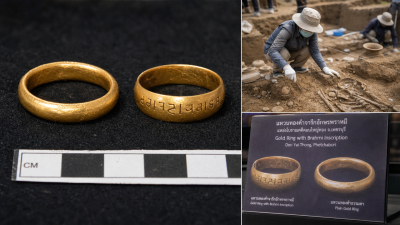
On 6 July 2026 archaeologists announced the recovery of two c. 2,000-year-old gold rings at Don Yai Thong, Phetchaburi province; one ring bears a Brahmi inscription tentatively read as “Pusarakhitasa” referencing the Pushya nakshatra.
Site and chronology
- Location: Don Yai Thong, Phetchaburi province, ~130 km south‑west of Bangkok.
- Period: Late prehistoric Iron Age; regional dates c. 1,500–2,500 years BP.
Principal finds
- Inscribed gold ring: Brahmi script inscription read as “Pusarakhitasa” — interpreted as “one protected by Pushya”.
- Plain gold ring: Uninscribed band recovered from same burial context.
- Associated assemblage: Eight human skeletons, gold and bronze ornaments, and pottery consistent with high‑status or ceremonial interments.
Archaeological and historical implications
- Epigraphic link: Brahmi presence attests to early use of South Asian script forms in mainland Southeast Asia around the turn of the Common Era.
- Trade and identity: Inscription and grave goods support identification of the buried individual as a merchant (Vaishya) and point to long‑distance commercial and cultural networks.
IASPOINT Booster Facts
- Brahmi: Early Indian script family (used c. 3rd century BCE–3rd century CE); progenitor of most Indic scripts.
- Pushya: One of 27 nakshatras (lunar mansions) in classical Indian astronomy.
- Agency: Excavation overseen by Thailand’s Fine Arts Department; conservation and public display planned.