
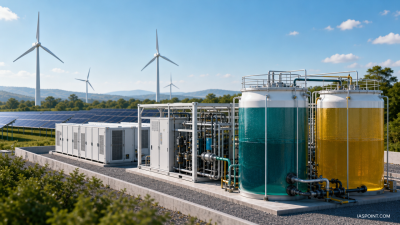
India has approved a 100 MWh vanadium redox flow battery energy storage system for Khavda Solar Park (Gujarat); NTPC Renewable Energy Limited awarded the contract in July 2026 for deployment in 2027 with 10 years of O&M.
Vanadium Redox Flow Battery (VRFB)
- Definition: Rechargeable flow battery using vanadium-based electrolytes stored in external tanks; energy capacity set by electrolyte volume, power by cell stack area.
- Chemistry: Vanadium ions operate across multiple oxidation states (V2+/V3+ and V4+/V5+) to prevent cross-contamination between half-cells.
- Performance traits: High cycle life, low self-discharge, capable of deep discharge and long-duration storage.
Project Specifics
- Scale: 100 MWh utility-scale VRFB — India’s first grid-scale vanadium flow battery.
- Location: Khavda Solar Park, Gujarat; park target 30 GW by 2029.
- Contracting: NTPC REL awarded the project (July 2026); Bondada Engineering — EPC; Delectrik Systems — technology partner.
- Timeline & O&M: Deployment in 2027 with 10 years of operations and maintenance services.
- Manufacturing: Reported 100% designed, engineered and manufactured in India using domestic vanadium resources.
Grid Role & Technical Comparison
- Functions: Energy shifting, renewable integration, frequency regulation and peak management at grid scale.
- Compared to lithium-ion: Decoupled energy and power enables scalable duration; lower capacity fade for long-duration cycling.
IASPOINT Booster Facts
- Classification: Flow batteries are a category of stationary electrochemical storage systems.
- Key parameters: MWh = stored energy; MW = instantaneous power; duration = MWh ÷ MW.
- Prior deployment: Delectrik Systems deployed a 3 MWh VRFB at Greater Noida in 2025.