
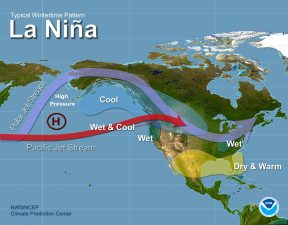
La Niña is climate phenomenon that affects global weather patterns. The National Oceanic and Atmospheric Administration (NOAA) recently confirmed the emergence of La Niña conditions in the Pacific Ocean as of December 2024. This event follows a period of warmer ocean temperatures, which may have delayed the onset of La Niña. About La Niña is crucial for predicting weather patterns, especially in regions like India.
What is La Niña?
La Niña is part of the El Niño Southern Oscillation (ENSO). It is characterised by cooler sea surface temperatures in the central and eastern tropical Pacific Ocean. This phenomenon occurs in cycles lasting two to seven years. La Niña typically follows an El Niño event, which features warmer sea temperatures. The last La Niña occurred from 2020 to 2023, while the preceding El Niño was from 2023 to 2024.
Mechanism of La Niña
La Niña is driven by changes in wind patterns over the Pacific Ocean. During La Niña, trade winds strengthen, pushing warm water towards the western Pacific. This causes colder water to rise in the eastern Pacific. The resulting temperature differences can alter global weather patterns.
Impact on Weather Patterns
La Niña has distinct effects on global weather. In India, it is associated with increased rainfall and lower temperatures. Conversely, El Niño leads to reduced rainfall and higher temperatures in the region. The impacts of La Niña can lead to agricultural and economic consequences, especially in countries reliant on monsoon rains.
Current Forecast and Implications
Meteorologists predict that the current La Niña event will be weak. It is unlikely to reach thresholds, such as a Nino 3.4 index value below -0.1 degrees Celsius. The delayed onset of La Niña could lead to unpredictable weather outcomes, particularly given the warmer ocean temperatures observed over the past year.
Global Significance of ENSO
ENSO, including both El Niño and La Niña phases, plays a critical role in global climate variability. It influences precipitation patterns, storm activities, and temperature anomalies worldwide. About these phenomena is essential for climate forecasting and disaster preparedness.
Preparedness and Adaptation
Countries prone to the impacts of La Niña must enhance their preparedness. This includes improving weather forecasting systems and developing adaptive agricultural practices. Policymakers should consider the implications of La Niña in their climate action strategies.
Research and Monitoring
Ongoing research is vital to understand the complexities of La Niña and its global impacts. Continuous monitoring of sea surface temperatures and atmospheric conditions is necessary to refine predictive models and improve response strategies.
Conclusion
La Niña is a complex climate phenomenon with far-reaching effects. Its emergence requires close monitoring and understanding to mitigate potential impacts, particularly in vulnerable regions.
Questions for UPSC:
- Examine the role of the El Niño Southern Oscillation in global weather patterns.
- Discuss the effects of La Niña on agricultural productivity in India.
- Analyse the relationship between sea surface temperatures and climate variability.
- Critically discuss the importance of climate monitoring in mitigating natural disasters.
Answer Hints:
1. Examine the role of the El Niño Southern Oscillation in global weather patterns.
- ENSO consists of three phases – El Niño, La Niña, and neutral, affecting global climate variability.
- El Niño leads to warmer sea surface temperatures, resulting in altered precipitation and storm patterns.
- La Niña causes cooler sea surface temperatures, influencing weather patterns such as increased rainfall in India.
- ENSO events can disrupt normal atmospheric circulation, impacting global weather systems and climate extremes.
- ENSO’s irregular cycles (2-7 years) complicate long-term climate predictions and require ongoing monitoring.
2. Discuss the effects of La Niña on agricultural productivity in India.
- La Niña is associated with increased rainfall, benefiting crop yields in rain-fed agricultural regions.
- Higher rainfall can enhance water availability for irrigation, improving agricultural productivity.
- However, excessive rainfall may lead to flooding, damaging crops and infrastructure.
- Farmers may need to adapt planting schedules and crop choices based on La Niña forecasts.
- About La Niña impacts can aid in better resource management and food security strategies.
3. Analyse the relationship between sea surface temperatures and climate variability.
- Sea surface temperatures (SSTs) are critical indicators of climate patterns, influencing atmospheric conditions.
- Warmer SSTs can lead to increased evaporation, affecting precipitation and storm intensity.
- Cooler SSTs, as seen in La Niña, can result in altered wind patterns and global temperature distributions.
- Changes in SSTs are linked to climate phenomena, including ENSO, affecting global weather systems.
- Monitoring SSTs is essential for predicting climate variability and preparing for extreme weather events.
4. Critically discuss the importance of climate monitoring in mitigating natural disasters.
- Climate monitoring provides data for predicting extreme weather events, enabling timely warnings.
- Accurate forecasts help in disaster preparedness and resource allocation for affected regions.
- Monitoring systems enhance understanding of climate patterns, aiding in risk assessment and management.
- Data-driven insights can guide policymakers in developing effective climate action strategies.
- Investing in climate monitoring infrastructure is crucial for reducing vulnerability to natural disasters.