
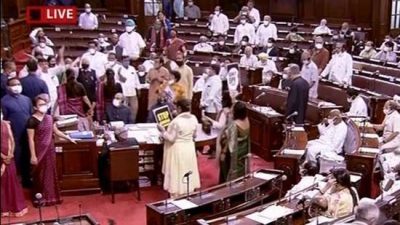
In recent developments, the Supreme Court of India has brought into light the critical role of whips in maintaining party discipline within legislative assemblies. This discussion arises from the political crisis in Maharashtra, particularly concerning the Shiv Sena party’s factions. The court’s observations emphasise that members of a political party must adhere to the directives of their party’s whip, reinforcing the importance of party loyalty in governance.
Definition of a Whip
A whip is a formal order issued by a political party to its members in the legislature. It instructs them on how to vote on specific issues. The term originates from British parliamentary practice, where lawmakers were “whipped in” to follow party lines. In India, every political party can issue whips, and they appoint a chief whip to oversee this process.
Types of Whips
Whips can vary in seriousness.
- A one-line whip informs members about a vote and allows abstention.
- A two-line whip mandates attendance during voting.
- A three-line whip is the most stringent. It obligates members to vote in alignment with the party’s stance, especially during critical votes such as budget approvals or no-confidence motions.
Consequences of Defying a Whip
Defying a whip can lead to severe repercussions. In India, if a member disobeys a three-line whip, they risk disqualification under the anti-defection law. This law empowers the Speaker to disqualify members who do not follow party directives unless portion of the party (more than one-third) votes against the whip.
Recent Legal Context in Maharashtra
The Supreme Court’s recent deliberations stem from the political turmoil in Maharashtra, where a split in the Shiv Sena led to competing factions. The court clarified that once a government is formed, no faction within a party can unilaterally decide to withdraw from an alliance. Such actions can lead to disqualification as per the law.
Arguments from Political Factions
The Shinde faction of the Shiv Sena has contested the authority of the Uddhav Thackeray faction’s whip. They argue that their faction, recognised by the Election Commission, represents the true mandate of the party. This ongoing dispute marks the complexities of party loyalty and factionalism in Indian politics.
Importance of Whips in Governance
Whips play a vital role in ensuring legislative stability. They help maintain party cohesion and streamline decision-making processes. By enforcing discipline, whips ensure that parties can present a united front on critical issues, which is essential for effective governance.
Global Comparisons
The concept of a whip is not unique to India. In the UK, defying a party whip can lead to expulsion from the party but allows the member to remain in Parliament as an Independent. In the US, whips primarily gauge support for legislation rather than enforce party discipline strictly.
Questions for UPSC:
- Critically analyse the implications of the anti-defection law on party dynamics in India.
- What are the global practices regarding the role of whips in parliamentary systems? Comment on their effectiveness.
- Explain the significance of party loyalty in a parliamentary democracy. How does it affect governance?
- What defines a political faction in a party? Discuss with suitable examples from Indian politics.
Answer Hints:
1. Critically analyse the implications of the anti-defection law on party dynamics in India.
- The anti-defection law aims to prevent political instability by discouraging party switching among legislators.
- It reinforces party loyalty, making it difficult for factions to break away without risking disqualification.
- The law can lead to a lack of representation for dissenting voices within parties, potentially stifling democratic debate.
- It may create an environment of fear among legislators, limiting their ability to act independently.
- However, it can also strengthen party cohesion and facilitate smoother governance when parties present a united front.
2. What are the global practices regarding the role of whips in parliamentary systems? Comment on their effectiveness.
- In the UK, whips are crucial for party discipline, with serious penalties for defiance, including expulsion from the party.
- In the US, whips primarily gauge support rather than enforce strict voting discipline, focusing on persuasion.
- Many countries use a tiered whip system, similar to India, indicating varying levels of urgency and importance in votes.
- Effectiveness varies; strict systems may ensure cohesion but can suppress individual opinions, while looser systems promote debate.
- Overall, whips are essential for maintaining order in legislative processes, but their impact on democracy can be contentious.
3. Explain the significance of party loyalty in a parliamentary democracy. How does it affect governance?
- Party loyalty ensures stability in governance by promoting a unified approach to legislation and policy-making.
- It allows for efficient decision-making, as parties can present coherent platforms during elections and governance.
- However, excessive loyalty may lead to blind adherence to party lines, undermining accountability and critical debate.
- Strong party loyalty can marginalize dissenting voices, potentially alienating constituents who seek diverse representation.
- Ultimately, a balance between loyalty and independent judgment is crucial for healthy democratic practices and effective governance.
4. What defines a political faction in a party? Discuss with suitable examples from Indian politics.
- A political faction is a subgroup within a larger political party, often formed around specific interests or leadership.
- Factions can emerge due to ideological differences, leadership disputes, or regional interests, as seen in the Shiv Sena’s split.
- The Congress party has historically experienced factions, such as the G-23 group advocating for internal reforms.
- Factions can influence party dynamics, affecting decision-making and electoral strategies, as seen in coalition politics.
- Recognition by authorities, such as the Election Commission, can legitimize a faction’s claims, impacting party identity and electoral outcomes.