
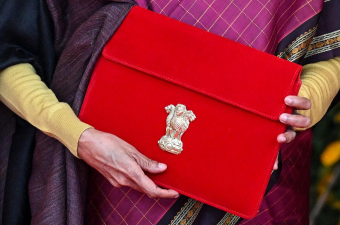
Markets are often quick to judge and slow to reflect. The initial selloff after the Union Budget 2026–27, driven by concerns over headline borrowing, was a case in point. Yet as indices recovered, aided by positive external cues, a deeper reading of the Budget reveals something more consequential than short-term market sentiment: a fiscally disciplined state making a deliberate bet on India’s long-term economic capacity.
Why markets misread the budget initially
The early market reaction centred on the gross borrowing number of ₹17.2 trillion, which appeared elevated in isolation. Bond investors responded nervously, overlooking two nuances. First, net borrowing presents a more balanced picture. Second, a significant portion of government borrowing is historically financed through small savings, reducing pressure on bond markets.
This disconnect highlights a familiar tension. Markets often prioritise immediate visibility and certainty, while structural reforms — especially fiscal ones — take time to be understood and rewarded.
Fiscal consolidation continues, quietly but firmly
The 2026–27 Budget builds on several years of fiscal consolidation. Both revenue and expenditure are projected to contract relative to GDP — by 0.25 and 0.30 percentage points respectively — yielding a fiscal deficit reduction of 0.05 percentage points.
Operational spending, including administrative costs and central schemes, is set to grow slower than the economy. Revenue expenditure, including interest payments, continues to decline as a share of GDP. Fertiliser and food subsidies have eased further, freeing up fiscal space without abrupt cuts.
This restraint is notable not just economically, but politically. The absence of pre-election spending excesses signals a maturing political economy where macroeconomic stability is prioritised over short-term populism.
Capital expenditure takes centre stage
A defining feature of the Budget is the sharp improvement in the quality of expenditure. Once grants to states for capital projects are included, the effective capital-to-current spending ratio is expected to approach 50% in 2026–27, up from less than 40% a year earlier.
This rebalancing reflects a strategic shift: away from consumption-led fiscal expansion and towards long-term capacity creation — infrastructure that lowers transaction costs, institutions that enable private investment, and public goods that raise productivity.
Conservative assumptions, credible projections
What lends credibility to these fiscal choices is the government’s conservative macroeconomic assumptions. Nominal GDP growth is projected at around 10%, with modest expectations built into inflation and the GDP deflator.
Historically, such caution has allowed Budgets to outperform rather than disappoint. By building buffers rather than optimism into projections, the government strengthens its credibility with markets and rating agencies.
That said, risks remain. The Centre’s debt anchor under the medium-term fiscal framework could be tested if nominal growth undershoots. Combined with states’ debt — now close to 28% of GDP — overall public sector borrowing remains high, an issue markets will continue to monitor closely.
Tax choices and consumption support
Revenue compression is partly deliberate. Reductions in income tax and GST aim to boost household consumption by putting more disposable income in citizens’ hands. This has lowered tax buoyancy below one, with a sustained moderation expected.
Non-tax revenues, buoyed in 2025–26 by a sharp rise in telecom licence fees and spectrum charges, are expected to normalise. The Budget avoids extrapolating temporary windfalls, reinforcing its conservative stance.
Structural reforms embedded in the numbers
Beyond fiscal arithmetic, the Budget reveals a clear development strategy. Employment generation is anchored in expanding India’s global services share to 10% by 2047. Tourism is positioned as a labour-intensive growth engine, alongside export promotion in textiles and leather.
Industrial competitiveness is addressed through duty-free imports of critical inputs and the expansion of textile parks. Urbanisation receives renewed focus, acknowledging that future growth will increasingly be city-led.
A particularly bold signal is the tax holiday for foreign cloud service providers up to 2047. This underscores India’s ambition to emerge as a global digital infrastructure hub and capture higher-value segments of technology supply chains.
Human capital and cities as growth drivers
Complementing physical infrastructure are investments in education, research, and skilling. These are essential for sustaining growth in a knowledge-intensive global economy. The emphasis on urban development reflects an understanding that productivity gains will increasingly come from well-functioning cities rather than dispersed rural subsidies.
Debt, divestment, and execution risks
Two cautionary notes stand out. Interest payments have risen sharply as a share of revenues, constraining fiscal flexibility in a high interest-rate environment. This makes continued consolidation imperative.
Second, divestment targets have been raised significantly. While this may reflect projects at advanced stages, past experience suggests execution risks remain. Achieving these targets will be critical to maintaining fiscal credibility.
What the budget ultimately signals
The significance of the 2026–27 Budget lies less in its immediate numbers and more in its philosophy. It avoids grand narratives about India’s global moment and instead focuses on domestic fundamentals — ease of doing business, infrastructure, human capital, and institutional reform.
By resisting external excuses and electoral temptations, the Budget reflects a seriousness of purpose. Markets may not immediately reward such restraint, but over time, credible fiscal discipline combined with capacity-building reforms is precisely what sustains growth and confidence.
What to note for Prelims?
- Fiscal deficit and debt-to-GDP trajectory.
- Difference between revenue and capital expenditure.
- Concept of tax buoyancy and nominal GDP assumptions.
What to note for Mains?
- Assess the quality of fiscal consolidation in Budget 2026–27.
- Discuss the role of capital expenditure in long-term growth.
- Analyse the trade-off between market sentiment and structural reform.
- Evaluate India’s evolving fiscal strategy in a high-debt environment.