
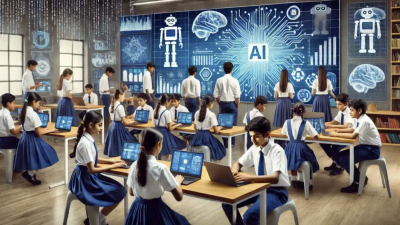
The Central Board of Secondary Education (CBSE) has announced compulsory training in Artificial Intelligence (AI) and computational thinking for all affiliated schools starting from the academic year 2026–27. This directive applies to students from classes VI to XII across India. The initiative aims to integrate AI concepts into the existing curriculum through a structured framework.
Implementation Framework
CBSE will introduce AI and computational thinking as part of the regular curriculum under a phased approach. The syllabus includes foundational AI concepts, data handling, machine learning basics, and algorithmic problem-solving. Schools will receive detailed guidelines and teaching resources by mid-2025. Teacher training programmes will be conducted nationwide to prepare educators for effective delivery.
Curriculum Structure
The new curriculum is designed to span multiple subjects, including mathematics, science, and computer science. It emphasises practical learning through project work, coding exercises, and AI applications. Computational thinking modules will focus on problem decomposition, pattern recognition, abstraction, and algorithm design. Assessment will be both formative and summative, incorporating theoretical and practical components.
Teacher Training and Resources
CBSE plans to train over 50,000 teachers before the rollout. Training will be organised through regional centres and online platforms. Certified trainers will conduct workshops on AI concepts, pedagogical methods, and use of digital tools. Schools will be provided access to open-source software, AI kits, and digital libraries to support classroom activities.
Expected Coverage and Monitoring
The mandate covers approximately 20,000 CBSE-affiliated schools nationwide. CBSE will monitor implementation through periodic reviews and feedback mechanisms. Schools are required to submit progress reports biannually. An AI advisory committee will oversee curriculum updates and address challenges during the initial years of implementation.
What to Study for UPSC Exams?
- Artificial Intelligence Education Policy
- Computational Thinking Concepts
- CBSE Curriculum Reforms
- Teacher Training Programmes
Artificial Intelligence Education Policy
AI education policies often prioritize ethical AI and data privacy alongside technical skills. Some nations mandate AI literacy from early schooling, integrating interdisciplinary approaches combining humanities and technology. Policy frameworks increasingly emphasize equity in access to AI resources to bridge digital divides.
Computational Thinking Concepts
Computational thinking involves decomposition, pattern recognition, abstraction, and algorithm design. It originated from computer science education but applies broadly to problem-solving in diverse fields. It fosters automation of repetitive tasks and enhances logical reasoning beyond programming.
CBSE Curriculum Reforms
CBSE reforms often align with national education policies and global trends. Recent reforms include competency-based learning and integration of skill development modules. Emphasis on project-based assessment and digital literacy has increased since 2020.
Teacher Training Programmes
Effective teacher training combines content knowledge with pedagogical skills and technology use. Blended learning models using both in-person and online formats improve accessibility. Continuous professional development is linked to better student outcomes and curriculum adaptability.
Last Modified: April 11, 2026