
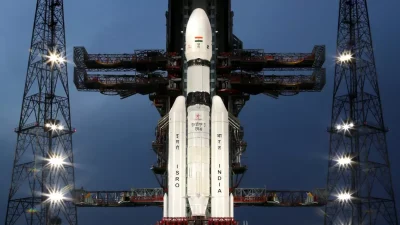
On July 14, the Indian Space Research Organisation (ISRO) successfully launched its third lunar mission, Chandrayaan 3, from Sriharikota. This ambitious mission aims to further India’s exploration of the Moon and demonstrate advanced technologies required for inter-planetary missions. The mission’s Vikram lander is scheduled to touch down on the lunar surface’s South Pole region on August 23, marking a significant milestone in India’s space exploration endeavors.
Exploring the Lunar Surface:
Chandrayaan 3 is India’s third lunar mission, following the successful Chandrayaan 1 and Chandrayaan 2 missions. The spacecraft consists of an indigenous lander module (LM), propulsion module (PM), and a rover. Its primary objective is to develop and demonstrate new technologies that will be crucial for future inter-planetary missions.
Components of Chandrayaan 3:
The Chandrayaan 3 mission comprises three modules: the propulsion module, lander module, and rover. The propulsion module is responsible for transporting the lander and rover to the Moon. Once the spacecraft reaches its destination, the lander module will safely deliver the rover to the lunar surface, where it will embark on scientific exploration.
Key Payloads:
Chandrayaan 3 carries a range of scientific payloads that will contribute to our understanding of the Moon’s composition and structure. Some of the notable payloads include:
- Radio Anatomy of Moon Bound Hypersensitive ionosphere and Atmosphere (RAMBHA): RAMBHA will measure the near-surface plasma density on the Moon and study its variations over time. This data will provide valuable insights into the lunar atmosphere and ionosphere.
- Instrument for Lunar Seismic Activity (ILSA): ILSA’s primary objective is to measure seismic activity in the vicinity of the landing site. By studying lunar seismicity, scientists aim to gain a deeper understanding of the Moon’s internal structure and composition.
- Laser-Induced Breakdown Spectroscope (LIBS): LIBS will analyze the elemental composition of lunar soil and rocks around the landing site. This information will help scientists decipher the Moon’s geological history and formation processes.
- Alpha Particle X-Ray Spectrometer (APXS): APXS will provide valuable data on the chemical composition and mineralogy of the lunar surface. By analyzing the Moon’s rocks and soil, scientists can gain insights into its geological evolution.
- Spectro-polarimetry of HAbitable Planet Earth (SHAPE): SHAPE’s objective is to study the spectro-polarimetric signatures of the Earth in the near-infrared wavelength range. This research has implications for the search for life on exoplanets beyond our solar system.
Photography and Seismic Studies:
In addition to the scientific payloads, the lunar lander Vikram will capture photographs of the rover Pragyaan as it carries out its exploration activities. These images will provide visual documentation of the mission’s progress and findings. Furthermore, the rover will study the Moon’s seismic activity by deploying specialized instruments, further expanding our knowledge of the Moon’s geology.
Last Modified: February 22, 2024