
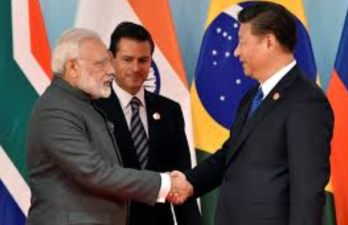
Recent developments reveal China’s persistent subversion of the rules-based global order. Its state-led economic model flouts World Trade Organization norms through heavy subsidies, intellectual property theft, and forced technology transfer. Militarily, China defies international law, notably rejecting the 2016 South China Sea arbitration ruling, while exerting pressure on Taiwan and supporting Russia’s invasion of Ukraine. The United States, under the Trump administration, responded with broad tariffs to compel behavioural change. This standoff resembles a high-risk geopolitical game of chicken, with both nations showing internal vulnerabilities that urge de-escalation. India, meanwhile, faces a unique chance to deepen its global integration and leverage shifting dynamics.
China’s Economic and Security Challenges
China’s economy suffers from structural weaknesses. The property sector’s collapse has triggered a solvency crisis for developers and local governments reliant on land sales. This strain extends to banks exposed to these sectors. State-driven industrial overcapacity in steel, solar panels, and electric vehicles worsens vulnerabilities amid tariffs. Economic nationalism has dampened private-sector confidence, pushing youth unemployment to record highs. Militarily, China disregards international rulings and pressures neighbours, undermining regional stability.
US Tariff Policy and Economic Impact
The US tariffs aim to force China to alter its trade practices. However, these tariffs disrupt American supply chains and raise costs for manufacturers and consumers. Economic growth in the US has slowed, aside from gains in artificial intelligence investment. Inflationary pressures persist, and the dollar has weakened substantially. The tariffs thus impose domestic economic costs, complicating the US position in this trade conflict.
The Geopolitical Game of Chicken
The US-China confrontation is a standoff where neither side wants to yield first. Both project strength despite internal economic and political challenges. China’s economic crisis and US domestic costs create pressures to find a compromise. Yet, nationalist pride and political calculations maintain the rhetoric. The risk of escalation remains, but extreme protectionism may be temporary as both seek relief.
India’s Strategic Opportunity
India can capitalise on this volatile environment by pursuing deeper global integration. Prioritising a comprehensive trade and investment agreement with the US would stabilise a key partnership and unlock synergies in technology and finance. Removing tariff and non-tariff barriers is essential. India must also accelerate free-trade agreements with the European Union, United Kingdom, Japan, and Taiwan to encourage institutional improvements and enhance governance.
Domestic Reforms and Globalisation Imperative
To seize these opportunities, India needs fundamental domestic reforms. Regulatory overhaul, tax reform, judicial efficiency, and labour and land law modernisation are crucial. These changes will boost investor confidence and private investment. Indian firms must globalise by engaging with foreign capital and technology. Competing internationally reduces reliance on state support and increases competitiveness. Preference should be given to partnerships with stable, high-trust liberal democracies.
Questions for UPSC:
- Discuss in the light of recent global trade tensions, how state-led economic models impact the rules-based international order.
- Critically examine the role of tariff policies in international trade disputes and their effects on domestic economies, with examples from recent US-China relations.
- Explain the significance of comprehensive trade agreements in enhancing a country’s geopolitical influence and economic growth. With suitable examples, discuss India’s strategy in this context.
- Comment on the importance of domestic structural reforms in supporting global economic integration and competitiveness. How can reforms in regulation, taxation, and labour laws influence foreign investment?
Answer Hints:
1. Discuss in the light of recent global trade tensions, how state-led economic models impact the rules-based international order.
- State-led models often use heavy industrial subsidies, distorting fair competition and violating WTO principles.
- Such models may enforce forced technology transfers and intellectual property theft, undermining global trade norms.
- They create chronic overcapacity, flooding global markets and triggering retaliatory tariffs and trade barriers.
- State control can lead to non-tariff barriers, restricting market access for foreign firms.
- These practices erode trust in the rules-based order, encouraging other countries to adopt protectionist or retaliatory measures.
- Example – China’s economic policies challenge WTO norms, causing friction with the US and other advanced economies.
2. Critically examine the role of tariff policies in international trade disputes and their effects on domestic economies, with examples from recent US-China relations.
- Tariffs are used as leverage to compel behavioural changes in trade partners (e.g., US tariffs on China to curb unfair practices).
- Broad tariffs disrupt global supply chains, increasing costs for domestic manufacturers and consumers.
- They act like taxes, feeding inflation and reducing purchasing power within the imposing country.
- Tariffs can provoke retaliatory measures, escalating trade conflicts and global economic uncertainty.
- In the US-China case, tariffs slowed US economic growth (except AI sector) and weakened the US dollar.
- While intended to protect domestic industries, tariffs often harm the imposing country’s economy in the short to medium term.
3. Explain the significance of comprehensive trade agreements in enhancing a country’s geopolitical influence and economic growth. With suitable examples, discuss India’s strategy in this context.
- Comprehensive trade agreements reduce tariffs and non-tariff barriers, facilitating smoother market access and investment flows.
- They deepen strategic partnerships, aligning countries politically and economically (e.g., India-US trade agreement efforts).
- Such agreements encourage technology transfer, finance cooperation, and services integration, boosting economic growth.
- India aims to leverage FTAs with the US, EU, UK, Japan, and Taiwan to strengthen global ties and governance standards.
- These agreements help position India as a China +1 alternative, attracting global supply chains seeking diversification.
- They also promote institutional reforms and higher domestic regulatory standards through spillover effects.
4. Comment on the importance of domestic structural reforms in supporting global economic integration and competitiveness. How can reforms in regulation, taxation, and labour laws influence foreign investment?
- Reforms improve ease of doing business, reducing bureaucratic delays and regulatory uncertainty.
- Modernizing taxation (e.g., unified GST) simplifies compliance, increasing investor confidence and revenue predictability.
- Labour and land law reforms enhance flexibility, lowering operational costs and attracting manufacturing investment.
- Efficient judicial enforcement protects contracts and property rights, crucial for foreign investors.
- Structural reforms reduce rent-seeking, promote innovation, and boost firm competitiveness globally.
- India’s reform agenda aims to create a stable, transparent environment encouraging both domestic and foreign private investment.