
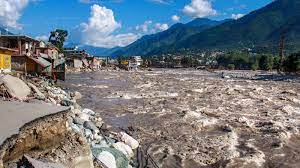
In a tragic turn of events, more than 50 lives have been lost within a mere 24-hour span due to heavy rains in Himachal Pradesh. Chief Minister Sukhvinder Singh Sukhu has reported that not only landslides but also cloudbursts have wreaked havoc in the state. Cloudbursts, characterized by intense local rainfall, have been responsible for widespread destruction in various regions.
Cloudbursts
A cloudburst denotes a concentrated and forceful episode of rainfall, with a potential for significant devastation. These events are particularly common during the monsoon season, and are prevalent in the Himalayan states. Cloudbursts differ from general heavy rainfall, as they necessitate a specific criterion. Rainfall of 10 cm or more within an hour, covering an approximate 10 km x 10 km area, is categorized as a cloudburst event. Even a rainfall of 5 cm within half an hour in the same area qualifies as a cloudburst.
Impacts of Cloudbursts
Due to the challenging terrain, heavy rainfalls linked with cloudbursts often trigger landslides and flash floods, resulting in significant destruction downstream. Although these events manifest in small regions lacking rainfall measurement instruments, their repercussions transcend these limited areas.
Forecasting Cloudbursts
While the India Meteorological Department (IMD) provides advance warnings for rainfall events, predicting the exact quantum of rainfall remains elusive. Meteorological agencies can forecast light, heavy, or very heavy rainfall for larger geographical areas like regions, states, or districts. However, as the area decreases, forecasts become progressively uncertain. Technically, forecasting rain over smaller areas requires a dense network of weather instruments and substantial computing capabilities, which remain challenging with current technology.
Cloudburst Incidents
Long-term data suggests that defined cloudbursts, as per IMD criteria, do not exhibit a significant increasing trend. Yet, instances of extreme rainfall and other extreme weather events are on the rise globally. While the overall volume of rainfall in India hasn’t drastically changed, a growing proportion of rainfall occurs in short durations. This phenomenon, attributed to climate change, implies that cloudburst events might be increasing due to the intensification of wet spells.
Landslides: Unearthing the Causes
A landslide involves the movement of rocks, debris, or earth down a slope, commonly occurring in mountainous terrains. Natural triggers include heavy rainfall, earthquakes, snow melting, and flooding-induced undercutting of slopes. Anthropogenic activities such as excavation, deforestation, and infrastructure development can also induce landslides. Rainfall-induced landslides are more prevalent in India.
India’s Vulnerability to Landslides
India ranks among the top five landslide-prone countries globally. The nation experiences about one death per 100 sq. km annually due to landslide incidents. The variability in rainfall patterns, particularly in the Himalayas and Western Ghats, is a leading cause of landslides. Roughly 12.6% of India’s geographical area is susceptible to landslides, with the North-western Himalayas accounting for 66.5%, the North-eastern Himalayas for 18.8%, and the Western Ghats for 14.7% of reported landslide events.
Meteorological Factors behind the Himachal Pradesh Deluge
The recent heavy rains in Himachal Pradesh and Uttarakhand can be attributed to the northward movement of the monsoon trough and its interaction with a weak western disturbance. The monsoon trough, an elongated low-pressure region, usually extends from Pakistan to the Bay of Bengal region. It has now shifted northwards over the Himalayan foothills due to a weak western disturbance. As the trough moves southward, rainfall is expected to shift from the hills to east-central India.
UPSC Mains Questions
- How do cloudbursts differ from general heavy rainfall, and why do they often lead to landslides and flash floods?
- While cloudbursts might not show an increasing trend, what broader climatic trend could contribute to the rising frequency of extreme rainfall events?
- What factors make India particularly susceptible to landslides, and how does the variability in rainfall patterns exacerbate this vulnerability?