
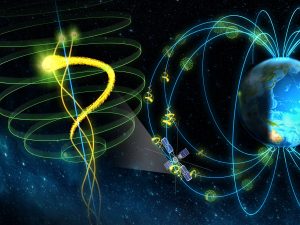
Recent research has shed light on how electrons travel vast distances in space and acquire ultra-high energy. A study conducted by the Applied Physics Laboratory at Johns Hopkins University and Northumbria University revealed that collisionless shock waves are drivers of subatomic particles. Published in Nature Communications, this study proposes a new model explaining electron acceleration in cosmic environments.
About Collisionless Shock Waves
Collisionless shock waves are prevalent throughout the universe. They occur in plasma, a state of matter consisting of charged particles that can conduct electricity. Unlike solids, liquids, and gases, plasma has a lower density and allows particles to interact primarily through electromagnetic forces rather than direct collisions.
Mechanism of Energy Transfer
In plasma, shock waves transfer energy by riding the electromagnetic forces between particles. This process differs from traditional shock waves, which rely on particle collisions. The energy from the shock wave pushes electrons forward, potentially accelerating them to relativistic speeds, close to the speed of light.
Electron Injection Problem
The study addresses the electron injection problem. This phenomenon refers to the challenge of understanding how electrons can be initially accelerated to speeds before being further propelled by shock waves. Researchers focused on diffusive shock acceleration, a mechanism requiring electrons to reach approximately 50% of the speed of light.
Data from NASA Missions
The findings were based on data from three NASA missions – the Magnetospheric Multiscale (MMS) mission, the Time-History of Events and Macroscale Interactions during Substorms (THEMIS) mission, and the Acceleration, Reconnection, Turbulence, and Electrodynamics of the Moon’s Interaction with the Sun (ARTEMIS) mission. The researchers analysed how solar wind interacts with Earth’s magnetosphere, revealing high-energy electron events.
High-Energy Electrons in the Foreshock Region
On December 17, 2017, data showed that electrons in the Earth’s foreshock acquired energy exceeding 500 keV. This was remarkable, given that typical energies in this region are around 1 keV. The high-energy electrons resulted from complex interactions between plasma waves and transient structures within the bow shock.
Implications for Cosmic Rays
The study provides new vital information about cosmic rays, high-energy particles travelling through space. The researchers suggest that supernova shocks might not be the sole source of cosmic rays. Their findings indicate that interactions between planetary shocks and stellar winds could also contribute to the cosmic ray distribution of relativistic electrons.
Call for Further Research
The researchers emphasise the need for more studies to validate their model. They encourage collaboration between the stellar astrophysics and particle acceleration communities to explore these cosmic phenomena further.
Questions for UPSC:
- Discuss the significance of collisionless shock waves in particle acceleration within astrophysics.
- Critically examine the role of plasma in the propagation of shock waves and its implications for cosmic energy transfer.
- Explain the electron injection problem in the context of high-energy particle acceleration mechanisms.
- With suitable examples, discuss how the interactions of solar wind with the Earth’s magnetosphere contribute to high-energy electron generation.
Answer Hints:
1. Discuss the significance of collisionless shock waves in particle acceleration within astrophysics.
- Collisionless shock waves are prevalent in various cosmic environments and serve as powerful particle accelerators.
- They can accelerate electrons to relativistic speeds, approaching the speed of light, which is crucial for understanding cosmic ray production.
- These shock waves operate in plasma, allowing energy transfer through electromagnetic forces rather than direct collisions.
- Research indicates that they could explain the acceleration mechanisms behind high-energy astrophysical phenomena.
- About these waves enhances our knowledge of energy propagation in the universe and the dynamics of astrophysical events.
2. Critically examine the role of plasma in the propagation of shock waves and its implications for cosmic energy transfer.
- Plasma is a state of matter consisting of charged particles, allowing for unique interactions through electromagnetic forces.
- In plasma, shock waves propagate without particle collisions, transferring energy via electromagnetic interactions instead.
- This low-density medium enables more efficient energy transfer, crucial for accelerating particles in cosmic environments.
- The characteristics of plasma affect the behavior of shock waves, influencing how energy is distributed in astrophysical processes.
- About plasma dynamics is essential for modeling cosmic phenomena and particle acceleration mechanisms.
3. Explain the electron injection problem in the context of high-energy particle acceleration mechanisms.
- The electron injection problem refers to the challenge of understanding how electrons are initially accelerated to speeds sufficient for further acceleration by shock waves.
- Diffusive shock acceleration requires electrons to reach around 50% of the speed of light before they can be propelled to higher energies.
- This initial acceleration process remains unclear, posing question in astrophysics.
- Research aims to identify natural processes in the universe that could provide this initial energy boost to electrons.
- Solving this problem is critical for comprehending the origins of high-energy cosmic rays and other astrophysical phenomena.
4. With suitable examples, discuss how the interactions of solar wind with the Earth’s magnetosphere contribute to high-energy electron generation.
- The solar wind is a stream of charged particles from the sun that interacts with Earth’s magnetosphere, creating shock waves.
- When the solar wind collides with the magnetosphere, it slows down, generating a bow shock where energy transfer occurs.
- Data from NASA missions revealed high-energy electrons in the Earth’s foreshock region, exceeding typical energy levels .
- These electrons were accelerated through complex interactions with plasma waves and transient structures within the bow shock.
- Such interactions illustrate how solar wind dynamics can lead to the generation of high-energy particles in our vicinity.