
The release of the “Congressionally-Mandated Report on Solar Radiation Modification” has sparked discussions about the potential of solar radiation modification to cool the Earth and address global warming.
Understanding the Report
The report acknowledges solar radiation modification as a controversial method that involves altering sunlight to mitigate the effects of global warming. It indicates the willingness of the Biden administration to explore this approach for achieving rapid cooling. However, it emphasizes the need for informed decision-making and a comprehensive understanding of the risks and benefits associated with solar radiation modification, considering it alongside other climate policies.
Importance of Informed Decision-Making
One of the report’s key takeaways is the importance of informed decision-making. While solar radiation modification holds the potential to provide benefits in combating global warming, it also poses risks to human health, biodiversity, and geopolitics. Altering sunlight could disrupt weather patterns and have unintended consequences on food supplies. Furthermore, if the intervention is abruptly halted, there is a potential for abrupt warming. Thus, careful consideration and thorough investigation of these risks are essential before any large-scale implementation of solar radiation modification.
International Cooperation and Research
The report underscores the significance of international cooperation in researching solar radiation modification. Collaboration among nations can help conduct comprehensive studies to assess the potential risks and benefits associated with altering sunlight. By sharing knowledge, resources, and expertise, the global community can collectively make informed decisions about the future of solar radiation modification.
Understanding Solar Radiation Management/Modification (SRM)
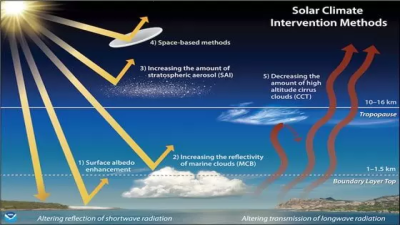
Solar Radiation Management (SRM) techniques aim to reflect a small portion of the Sun’s energy back into space, counteracting the temperature rise caused by greenhouse gas emissions. Some proposed SRM techniques include albedo enhancement, space reflectors, stratospheric aerosol injection (SAI), and cirrus cloud thinning.
Albedo Enhancement and Space Reflectors
Albedo enhancement involves increasing the reflectiveness of clouds or the land surface to reflect more of the Sun’s heat back into space. This technique aims to reduce the amount of sunlight absorbed by the Earth’s surface, thereby cooling the planet. Space reflectors, on the other hand, involve blocking a small proportion of sunlight before it reaches the Earth, further reducing the amount of solar energy absorbed.
Stratospheric Aerosol Injection (SAI)
SAI involves introducing small, reflective particles into the upper atmosphere to reflect sunlight back into space. These particles act as a shield, reducing the amount of solar radiation that reaches the Earth’s surface. While this method shows promise in cooling the planet, it also carries potential risks and requires further research and understanding.
Cirrus Cloud Thinning
Cirrus cloud thinning focuses on eliminating or thinning high-altitude cirrus clouds, which absorb more sunlight than they reflect. By reducing the cloud cover, heat can escape into space more easily, contributing to a cooling effect. However, this technique also needs careful evaluation to assess its feasibility and potential consequences.
Last Modified: February 22, 2024