
Daily Activities

UPSC Prelims Current Affairs

UPSC Mains Current Affairs

Current Affairs

Floating Solar Capacity in Indian Reservoirs

Floating Solar Capacity in Indian Reservoirs

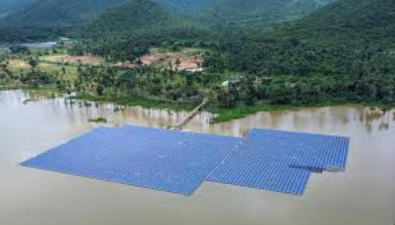
A report by the National Institute of Solar Energy (NISE) estimates that India’s reservoirs can support about 102 GW of floating solar capacity, offering a solution to land acquisition challenges faced by ground-mounted solar projects. The assessment used geospatial filters on inland water bodies and capped usable reservoir surface area at 20%, identifying Maharashtra, Madhya Pradesh, Karnataka, Odisha, and Telangana as top states for potential. Floating solar costs around 25% more upfront than ground systems, but can help India achieve its 500 GW non-fossil energy target by 2030. India’s largest floating solar project is the 278 MW Omkareshwar park on the Narmada river, with challenges in infrastructure durability noted during field studies.

Scientific Framework of the National Assessment

The report titled “Solar PV Potential of India (Floating Solar)” by NISE establishes the first comprehensive technical blueprint for Floatovoltaics or Floating Solar Photovoltaic (FSPV) deployment across the country.

Geospatial Filtering and Technical Metrics

The evaluation mapped 11,197 inland water bodies nationwide, identifying 682 sites as technically feasible. The framework applied specific site selection metrics to ensure structural and economic viability:

  • Water Depth: Water bodies must maintain a consistent depth between 3 meters and 30 meters.
  • Logistical Proximity: Sites must be located within 10 kilometers of established road networks and electrical transmission substations.
  • Surface Area Conservation: A self-imposed safety cap restricts panel coverage to a maximum of 20% of any single reservoir’s total surface area. This restriction preserves aquatic ecosystems, allows sunlight penetration, and maintains natural dissolved oxygen levels.
Aggregated Potential and Total Solar Horizon

Applying these filters narrowed down 10,725 square kilometers of gross water surface to 1,946 square kilometers of effective usable area. This capacity translates to exactly 102.18 GWp of floating solar potential. Adding this to the previously assessed ground-mounted solar potential increases India’s total estimated solar energy potential to 3,445 GWp.

State-Wise Distribution of FSPV Potential

The distribution of FSPV potential is concentrated across states with extensive irrigation networks, large dam reservoirs, and optimal solar insolation zones.

Top Performing States

Five states hold the vast majority of the identified 102.18 GWp capacity due to their large hydrological infrastructure layouts:

RankStateAssessed FSPV Potential (GWp)Key Hydrological Features
1Maharashtra16.28Extensive network of irrigation dams and water storage reservoirs.
2Madhya Pradesh14.89Massive reservoirs along the Narmada and Chambal river systems.
3Karnataka13.69Large-scale multi-purpose reservoirs in the Krishna and Cauvery basins.
4Odisha12.81Massive water bodies like the Hirakud reservoir system.
5Telangana10.72Extensive lift irrigation storage lakes and balancing reservoirs.

Comparative Economics: FSPV vs. Ground-Mounted Solar

FSPV systems present a distinct financial and operational profile when contrasted with traditional land-based installations.

Cost Disadvantages and Upfront Capital

FSPV arrays demand a 25% cost premium over ground-mounted equivalents. This capital expenditure inflation stems directly from specialized components:

  • High-Density Polyethylene (HDPE) pontoons and UV-resistant floating platforms.
  • Specialized underwater mooring systems, self-adjusting tension cables, and helical rock-bolt anchors.
  • Heavy-duty marine waterproofing for string inverters and flexible high-voltage cabling.
Performance Factors and Structural Paybacks

Despite the initial premium, FSPV provides operational advantages that offset the upfront expenditure:

  • Land Neutrality: Traditional solar farms require three to four times more physical area per megawatt than the panels occupy. FSPV bypasses complex land acquisition, local displacement conflicts, and agricultural land conversion.
  • The Thermodynamic Cooling Benefit: The underlying water body acts as a natural heat sink, lowering the operational temperature of the photovoltaic cells. This cooling effect improves solar panel generation efficiency by 5% to 11% compared to land installations exposed to extreme ambient heat.
  • Water Resource Conservation: Shading water surfaces with solar panels lowers evaporation rates by 30% to 60%. Implementing FSPV on large reservoirs can save millions of cubic meters of water annually, improving downstream irrigation security.

Operational Vulnerabilities and Field Realities

Field studies conducted by NISE highlight physical durability challenges that threaten long-term asset integrity.

Structural Risks at Omkareshwar Park

The 278 MW Omkareshwar project on the Narmada River in Madhya Pradesh serves as India’s premier utility-scale FSPV installation, with plans to scale to 600 MW. However, operational tracking revealed structural vulnerabilities under real-world conditions:

  • Wind and Wave-Induced Stress: High-velocity storm events have caused severe mechanical stress, resulting in broken electrical cables, misaligned floating platforms, and uneven buoyancy distribution.
  • Mooring Deficiencies: Extreme water level fluctuations at the dam put intense strain on anchoring lines, leading to loosening float joints and shifting panel orientations.

IASPOINT Booster Facts for UPSC

  • Nodal Research Agency: NISE is an autonomous national institution under the administrative control of the Ministry of New and Renewable Energy (MNRE), serving as the apex body for solar research and policy input.
  • Global Capacity Context: Globally, total installed FSPV capacity stood at approximately 9.6 GW, with Asian nations commanding nearly 90% of the aggregate operational deployment.
  • Co-location Hydro-Solar Synergy: FSPV deployment on existing hydropower reservoirs allows for direct infrastructure sharing, utilizing the same transmission lines and grid connections while balancing peak power requirements.
  • Agrivoltaics Parallel Support: To accelerate the 500 GW non-fossil capacity goal by 2030, MNRE is designing a dedicated dual financial support scheme targeting both Floating Solar and Agri-photovoltaics (dual-use farming).
  • Albedo Factor Variation: Water surfaces have a lower albedo (reflectivity) than typical land surfaces, meaning floatovoltaic designs must carefully calibrate localized solar radiation absorption to avoid altering surrounding water temperatures.
Last Modified: June 12, 2026

Leave a Reply

Your email address will not be published. Required fields are marked *

Archives