
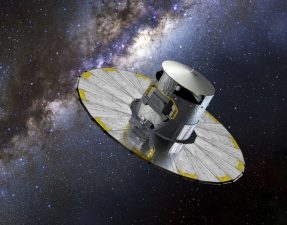
The European Space Agency (ESA) has officially concluded the Gaia mission on January 15, 2025. Launched in December 2013, Gaia has been very important in mapping the Milky Way galaxy. Over its operational period, Gaia took 3 trillion observations of approximately 2 billion stars and celestial objects. This data has contributed to over 13,000 scientific publications, fundamentally changing our understanding of the galaxy.
Overview of Gaia Mission
Gaia, originally named the Global Astrometric Interferometer for Astrophysics, was designed for astrometry. Its primary goal was to measure the precise positions and movements of stars. Positioned at the Lagrange point 2 (L2), Gaia avoided interference from Earth and other celestial bodies. This strategic location allowed for uninterrupted observations of the cosmos.
Technological Innovations
Gaia is equipped with twin telescopes and a digital camera featuring nearly a billion pixels, the largest of its kind in space. It utilises three main instruments – an astrometer for measuring star positions, a photometer for brightness, and a spectrometer for analysing light spectra. These tools have enabled Gaia to capture detailed data about the Milky Way’s structure and dynamics.
Discoveries and Contributions
Gaia has revolutionised our view of the Milky Way. It has revealed that the galaxy’s disc is not flat but warped and wobbles due to gravitational interactions with smaller galaxies. The mission has also uncovered new black holes, detected by their gravitational effects rather than emitted light, and identified over 150,000 asteroids, predicting their future orbits.
Retirement and Legacy
Following its mission, Gaia was successfully passivated, meaning it has been drained of energy and will not be reactivated. The spacecraft has drifted into a retirement orbit around the Sun to prevent interference with future missions. Although the mission has ended, amount of data remains to be processed. ESA plans to release portions of this data in the coming years, promising further discoveries and vital information about our galaxy.
Future Implications
Despite mapping only about 2% of the estimated 100 billion stars in the Milky Way, Gaia’s legacy will continue to influence astrophysics. The data collected will enable ongoing research and potentially reshape our understanding of galactic evolution and structure.
Questions for UPSC:
- Critically analyse the significance of the Lagrange point 2 in space missions.
- What are the implications of Gaia’s findings on our understanding of black holes? Discuss.
- Estimate the potential impact of Gaia’s data on future astronomical research and discoveries.
- Point out the technological advancements made in space observation since the launch of the Gaia mission.
Answer Hints:
1. Critically analyse the significance of the Lagrange point 2 in space missions.
- Lagrange point 2 (L2) offers a stable gravitational environment, minimizing interference from Earth, Sun, and Moon.
- Spacecraft at L2 can maintain continuous observation of celestial objects without atmospheric distortion.
- It allows for an unobstructed view of the cosmos, crucial for missions focused on deep-space observations.
- Other missions, like James Webb Space Telescope, also utilize L2 for similar advantages in astronomical research.
- Positioning at L2 enables efficient use of fuel, extending the operational lifespan of space missions.
2. What are the implications of Gaia’s findings on our understanding of black holes? Discuss.
- Gaia has discovered black holes based on their gravitational effects rather than emitted light, a novel detection method.
- This challenges traditional understanding of black hole detection and expands the criteria for identifying such objects.
- Identifying nearby black holes can provide vital information about their formation and evolution within the Milky Way.
- Gaia’s findings suggest a more complex and dynamic environment in the galaxy, influencing theories about black hole interactions.
- About black holes aids in comprehending the overall structure and behavior of galaxies, including our own.
3. Estimate the potential impact of Gaia’s data on future astronomical research and discoveries.
- Gaia’s extensive data set will facilitate ongoing research into stellar formation, evolution, and the dynamics of the Milky Way.
- It provides a foundational database for future studies, potentially leading to discoveries of new celestial phenomena.
- Data on asteroids helps in assessing threats to Earth and understanding the solar system’s evolution.
- Gaia’s findings can influence models of galactic evolution, reshaping our understanding of cosmic history.
- The release of remaining data will likely spur new scientific publications and collaborative research initiatives.
4. Point out the technological advancements made in space observation since the launch of the Gaia mission.
- Gaia’s twin telescopes and billion-pixel camera represent advancements in imaging technology for space observation.
- Improvements in astrometry techniques have enhanced the precision of measuring stellar positions and movements.
- Development of advanced spectrometry has enabled detailed analysis of light spectra from celestial bodies.
- Increased computational power allows for processing vast amounts of data, leading to more accurate astronomical models.
- Technological innovations in spacecraft design have improved the longevity and efficiency of missions like Gaia.