
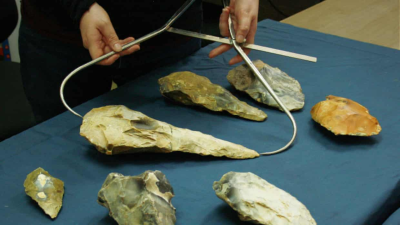
Excavations conducted in Kent have yielded remarkable findings that provide valuable insights into prehistoric life in Britain. Among the discoveries were an impressive collection of stone artifacts, including two giant handaxes and a Roman cemetery. These artifacts, preserved in deep ice age sediments, offer a glimpse into the lives of early humans and their interactions with the environment.
Unearthing Ancient Treasures:
The team of researchers involved in the excavations in Kent made an astonishing discovery of approximately 800 stone artifacts. Among them, two large flint knives, known as giant handaxes, stood out as the most notable finds. Handaxes are stone tools that were skillfully crafted on both sides through a process called knapping, resulting in a symmetrical shape with a long cutting edge.
The Giants of the Stone Age:
The two largest handaxes found at the site possess a distinctive shape, characterized by a long, finely worked, pointed tip and a considerably thicker base. These dimensions are so remarkable that researchers have labeled them as “giants” among handaxes. In fact, one of the handaxes measures a colossal 29.5cm in length, making it one of the longest ever found in Britain.
Significance of the Giant Handaxes:
Giant handaxes of this magnitude are typically associated with the Thames and Medway regions, dating back over 300,000 years. These tools provide valuable insights into the technological abilities and lifestyles of early human populations. The sheer size of the handaxes raises questions about their use and function, as it is difficult to imagine how they could have been easily held and wielded.
A Window into Prehistoric Kent:
The excavations in Kent have shed light on a period when Neanderthals and other early human species were emerging. The site’s location within the Medway Valley suggests a landscape teeming with wildlife, including red deer, horses, and now-extinct creatures like the straight-tusked elephant and lion. This rich environment would have provided abundant resources for survival and hunting.
Understanding Prehistoric Life:
The discovery of these ancient artifacts allows researchers to piece together the lives of early humans and their interactions with the environment. By examining the stone tools and their distribution patterns, archaeologists can gain insights into hunting techniques, resource exploitation, and the social dynamics of prehistoric communities. Such discoveries contribute to our understanding of human evolution and the cultural diversity that once existed.
Preserving Our Prehistoric Heritage:
The preservation of these stone artifacts in deep ice age sediments is a testament to the significance of archaeological excavations and the need for their careful preservation. These findings provide a tangible link to our ancient past and remind us of the importance of safeguarding our prehistoric heritage for future generations.
Last Modified: February 22, 2024