
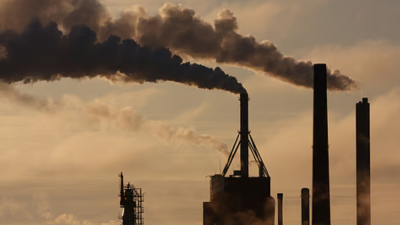
The Global Carbon Budget 2025 report, revealed at COP30 in Belém, Brazil, marks the critical state of the planet’s climate. Despite some positive signs, the world’s carbon dioxide emissions are reaching unprecedented levels. The report puts stress on the urgent need for stronger climate action as the goal to limit global warming to 1.5°C slips further away.
Current Global Emissions Trends
Recently, global fossil-fuel CO2 emissions are projected to hit a record 38.1 billion tonnes. This rise confirms that the global carbon curve is yet to bend downward. The world continues to emit greenhouse gases at a pace that threatens climate stability. The window to keep warming under 1.5°C is rapidly closing, with only 170 billion tonnes of carbon left to emit at current rates — about four years’ worth.
India’s Emissions and Climate Efforts
India’s carbon emissions are expected to grow by only 1.4 per cent in 2025, a slower rate than before. This is due to an early monsoon reducing energy demand and a rapid increase in renewable energy capacity. These factors helped restrain coal consumption. India remains among the top four emitters globally but offers a model where economic growth and climate resilience coexist. Between 2015 and 2024, 35 countries managed to grow their economies while reducing emissions.
Role of Natural Carbon Sinks
Forests and oceans act as natural carbon sinks, absorbing amounts of CO2. However, their efficiency is declining due to climate change itself. Since 1960, about 8 per cent of atmospheric CO2 rise is linked to the weakening of these natural buffers. This loss reduces the planet’s ability to heal and exacerbates climate risks.
Challenges and Responsibilities
Despite some progress, emissions are still rising in absolute terms. Developed nations remain the largest polluters and bear a greater responsibility to lead climate action. Their reluctance to fully commit hinders global efforts. The planet’s atmosphere and climate are shared resources; failure to cooperate endangers all. Incremental measures will not suffice in the face of the accelerating climate crisis.
Future Outlook and Urgency
The report warns that the global community must accelerate the transition to clean energy and adopt more ambitious policies. Without rapid and large-scale changes, the Earth risks becoming uninhabitable. The time to act decisively is now, as the consequences of delay grow more severe each year.
Questions for UPSC:
- Discuss in the light of the Global Carbon Budget 2025 report the challenges and prospects of balancing economic growth with climate change mitigation in developing countries.
- Critically examine the role of natural carbon sinks such as forests and oceans in regulating the Earth’s climate and the impact of their declining efficiency on global warming.
- Explain the concept of the global carbon budget and its significance in international climate negotiations. How can developed and developing countries share responsibilities effectively?
- With suitable examples, discuss the impact of renewable energy expansion on fossil fuel consumption and carbon emissions in emerging economies and the implications for global climate goals.
Answer Hints:
1. Discuss in the light of the Global Carbon Budget 2025 report the challenges and prospects of balancing economic growth with climate change mitigation in developing countries.
- Developing countries like India show slower emission growth (1.4% in 2025) due to renewable energy expansion and favorable climatic factors (early monsoon).
- Economic growth and climate resilience can coexist, as evidenced by 35 countries expanding economies while cutting emissions (2015-2024).
- Challenges include dependence on fossil fuels, rising absolute emissions, and limited financial/technological resources.
- Prospects lie in scaling up clean energy investments, adopting climate-conscious policies, and international support for green transitions.
- Developing nations face pressure to grow economically while meeting global climate goals, requiring balanced, sustainable development models.
- Global cooperation and technology transfer are crucial to help developing countries leapfrog to low-carbon pathways.
2. Critically examine the role of natural carbon sinks such as forests and oceans in regulating the Earth’s climate and the impact of their declining efficiency on global warming.
- Forests and oceans absorb CO2, acting as natural buffers that reduce atmospheric greenhouse gases.
- Since 1960, about 8% of CO2 rise is linked to climate change weakening these sinks’ absorption capacity.
- Declining sink efficiency accelerates atmospheric CO2 accumulation, exacerbating global warming and climate risks.
- Degradation of forests (deforestation) and ocean health (acidification, warming) further reduce sink effectiveness.
- Loss of natural sinks limits Earth’s ability to self-regulate climate and increases reliance on human mitigation efforts.
- Protecting and restoring these sinks is critical for climate stabilization and biodiversity conservation.
3. Explain the concept of the global carbon budget and its significance in international climate negotiations. How can developed and developing countries share responsibilities effectively?
- The global carbon budget is the maximum cumulative CO2 emissions allowable to keep warming below a target (e.g., 1.5°C), currently about 170 billion tonnes left.
- It quantifies the finite emission space remaining, emphasizing urgency in reducing emissions worldwide.
- Developed countries have historically emitted more and thus bear greater responsibility to reduce emissions and provide support.
- Developing countries need space for economic growth but must adopt low-carbon pathways with technology and finance aid.
- Effective sharing requires principles of equity, common but differentiated responsibilities, and enhanced climate finance.
- International negotiations use the carbon budget to set emission targets, timelines, and cooperation frameworks (e.g., Paris Agreement).
4. With suitable examples, discuss the impact of renewable energy expansion on fossil fuel consumption and carbon emissions in emerging economies and the implications for global climate goals.
- India’s rapid renewable capacity growth helped restrain coal use and slowed emission growth to 1.4% in 2025.
- Renewables reduce dependence on fossil fuels, lowering carbon emissions and improving energy security.
- Examples include solar and wind expansion in India, China, and Brazil contributing to cleaner energy mixes.
- Renewable expansion supports economic growth while mitigating climate change, aligning with global goals.
- Challenges include intermittency, infrastructure needs, and investment gaps in emerging economies.
- Scaling renewables globally is vital to bend the carbon curve downward and keep warming below 1.5°C.