
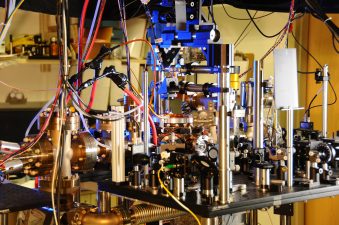
Recent advances in timekeeping have seen the world’s largest comparison of optical atomic clocks completed. This milestone is crucial for redefining the second, the fundamental unit of time. Current time measurement relies on caesium atomic clocks. However, optical atomic clocks offer precision up to 18 decimal places. Scientists expect them to replace caesium clocks by around 2030. The new global test involved 10 optical clocks across three continents and 65 researchers.
Evolution of Time Measurement
Time was once measured by Earth’s rotation and orbit. Early 20th century definitions linked one second to the solar day and later Earth’s revolution. These were replaced by atomic clocks in 1967. The second became defined by the frequency of radiation emitted by caesium-133 atoms. This frequency is 9,192,631,770 cycles per second. Atomic clocks count these cycles to measure time with extreme accuracy.
Working of Caesium Atomic Clocks
Caesium atoms absorb and emit energy at fixed frequencies. Microwave signals tuned to 9,192,631,770 Hz cause atoms to jump between energy states. The clock adjusts the microwave frequency to maintain maximum atomic transitions. Counting these cycles defines one second. Nations maintain caesium clocks to set their time standards. India’s National Physical Laboratory operates five such clocks, distributing time signals nationwide.
Need for Optical Atomic Clocks
Caesium clocks lose about one second every 300 million years. Optical clocks improve this by counting optical frequency waves, which are 10,000 times higher than microwaves. For example, strontium and ytterbium atoms emit light at frequencies over 400 trillion Hz. This allows measuring time with greater precision and stability. Optical clocks can drift less than one second in 15 billion years, ideal for advanced technologies like GPS, radio astronomy, and climate monitoring.
Global Comparison of Optical Clocks
The latest test linked 10 optical clocks at six institutes in Finland, France, Germany, Italy, the UK, and Japan. Clocks used atoms like strontium-87, ytterbium-171, and indium-115 ions. Connections used optical fibres and advanced GPS techniques called integer precise point positioning (IPPP). Backup clocks ensured continuous operation during maintenance. The clocks ran simultaneously for 45 days in early 2022.
Results and Challenges
Researchers measured 38 independent frequency ratios between clocks, including four never measured before. The closest agreement showed uncertainties as low as 4.4 × 10⁻¹⁸. Fibre and satellite links mostly agreed, confirming the reliability of long-distance synchronisation. Some discrepancies appeared, such as a signal glitch in Italy and small offsets between strontium clocks in France and Germany. These will require further investigation before redefining the second.
Significance of the Study
This large-scale, redundant comparison identified subtle errors and confirmed that optical clocks worldwide can synchronise to extraordinary precision. A correlation matrix was developed to avoid double-counting errors in future analyses. This work paves the way for adopting optical atomic clocks as the new global time standard by 2030. It will support technologies demanding ultra-precise timing and enhance scientific research.
Questions for UPSC:
- Critically analyse the importance of redefining the SI second with optical atomic clocks and its impact on global technologies.
- Explain the evolution of time measurement from astronomical methods to atomic clocks and discuss the scientific reasons for this transition.
- What are the challenges in synchronising atomic clocks across continents? How can satellite-based and fibre-optic communication technologies address these challenges?
- With suitable examples, comment on how ultra-precise timekeeping influences fields like navigation, astronomy, and climate science.