
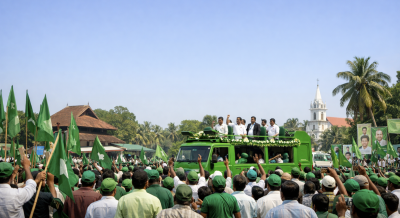
A unique election campaign is underway in Puthuppally, Kerala, ahead of the 2026 Assembly polls. Unlike traditional campaigns marked by plastic banners and loudspeakers, the United Democratic Front (UDF) candidate Chandy Oommen, son of former Chief Minister Oommen Chandy, is running an environmentally conscious campaign. He uses a bicycle to travel door-to-door, avoiding plastic flex boards and loud convoys. This marks departure from Kerala’s usual election culture, which often generates large amounts of non-biodegradable waste.
Traditional Election Campaigns in Kerala
Kerala elections have long been known for their visual and auditory intensity. Campaigns involve huge plastic flex boards, banners, and loudspeakers. These materials accumulate, creating environmental waste after polls. Despite regulations promoting eco-friendly practices, enforcement is weak. Political parties often treat environmental norms as formalities rather than commitments. This results in excessive plastic use and noise pollution during election seasons.
Oommen’s Green Campaign Approach
Chandy Oommen’s campaign rejects the usual extravagance. He travels by bicycle, making personal visits to voters without using microphones or vehicles. This slows the pace of politics and encourages direct, informal conversations. The campaign avoids plastic banners and posters, embodying sustainability rather than just promoting it. This approach challenges the norm and sets a precedent for low-impact political campaigning in India.
Environmental and Political Significance
The campaign marks the contradiction between political messaging and practice in Kerala. Environmental activists praise the move as a quiet revolution that could inspire others. It addresses multiple issues – climate change, waste management, traffic congestion, and social connection erosion. The campaign’s simplicity contrasts sharply with opponents who use traditional methods. This shift also honours the legacy of Oommen Chandy, who represented Puthuppally for over five decades.
Challenges and Broader Implications
While Oommen’s approach is environmentally sound, it faces the challenge of competing against conventional, resource-heavy campaigns. The real test lies in whether this style influences future elections and governance. If adopted widely, it could lead to more responsible political practices and policies, reducing environmental damage and enhancing grassroots engagement.
Topics for Prelims:
Oommen Chandy
- Served as Kerala Chief Minister twice.
- Represented Puthuppally constituency for 53 years.
- Known for accessibility and direct engagement.
- Died in 2023, creating a political legacy.
- Father of Chandy Oommen, current UDF candidate.
Green Election Campaign
- Avoids plastic flex boards and loudspeakers.
- Uses bicycle for candidate mobility.
- Focuses on door-to-door personal contact.
- Reduces election-related environmental waste.
- Challenges conventional political campaigning norms.
Puthuppally Constituency
- Located in Kerala, India.
- Known for intense political activity.
- Long associated with Oommen Chandy’s leadership.
- Site of closely watched 2026 Assembly election.
- Political culture marked by heavy campaign publicity.
Questions for Mains:
- Critically analyse the impact of traditional election campaigns on the environment and suggest sustainable alternatives. [GS-III-Environment & DM]
- With suitable examples, estimate the role of political legacy in shaping voter behaviour in state of India elections. [GS-II-Constitution of India & Polity]
- Point out the challenges and opportunities of grassroots political engagement in the context of modern Indian electoral politics. [GS-II-Governance]
- Underline the significance of environmentally conscious political campaigns in addressing climate change and public health issues. [GS-III-Science & Technology]
Answer Hints:
1. Critically analyse the impact of traditional election campaigns on the environment and suggest sustainable alternatives. [GS-III-Environment & DM]
- Traditional campaigns generate massive non-biodegradable waste, especially plastic flex boards, banners, and posters.
- Excessive use of loudspeakers contributes to noise pollution, affecting public health and wildlife.
- Weak enforcement of green protocols leads to continued environmental degradation despite regulations.
- Accumulated campaign waste creates disposal and management challenges post-elections.
- Sustainable alternatives include eco-friendly materials, zero-plastic campaigns, and low-impact mobility like bicycles.
- Door-to-door canvassing and digital outreach can reduce environmental footprint while enhancing voter engagement.
2. With suitable examples, estimate the role of political legacy in shaping voter behaviour in state of India elections. [GS-II-Constitution of India & Polity]
- Political legacy builds trust and familiarity, influencing voter loyalty and expectations (e.g., Oommen Chandy’s 53-year representation of Puthuppally).
- Legacy candidates often benefit from established networks and goodwill, aiding easier electoral success.
- Voter behaviour may reflect continuity desires, seen in Chandy Oommen’s bypoll victory with a large margin.
- Legacy can create both advantages and pressures to uphold past achievements and values.
- However, legacy must adapt to contemporary issues (e.g., ecological concerns) to remain relevant.
- Political legacy interacts with party identity, local development, and candidate accessibility in shaping outcomes.
3. Point out the challenges and opportunities of grassroots political engagement in the context of modern Indian electoral politics. [GS-II-Governance]
- Challenges include scaling personal outreach amid large electorates and resource constraints.
- Conventional campaigns often prioritize spectacle over direct voter interaction, weakening grassroots connect.
- Opportunities lie in door-to-door visits and informal conversations encouraging trust and issue-based dialogue.
- Grassroots engagement can counter political alienation and increase accountability and responsiveness.
- Use of low-cost, sustainable methods (e.g., bicycle campaigns) can enhance accessibility and environmental responsibility.
- Technology integration can complement but not replace the value of face-to-face contact in grassroots politics.
4. Underline the significance of environmentally conscious political campaigns in addressing climate change and public health issues. [GS-III-Science & Technology]
- Eco-friendly campaigns reduce plastic waste, mitigating pollution and landfill burden contributing to climate change.
- Lower noise pollution from absence of loud convoys benefits public health and reduces stress-related ailments.
- Promoting sustainable transport (e.g., bicycles) addresses traffic congestion and reduces carbon emissions.
- Environmentally conscious politics raise awareness and set precedents for green governance and policy-making.
- Such campaigns strengthen community engagement with climate issues, encouraging grassroots environmental responsibility.
- They symbolize integration of science-based sustainability with democratic processes, encouraging broader societal shifts.