
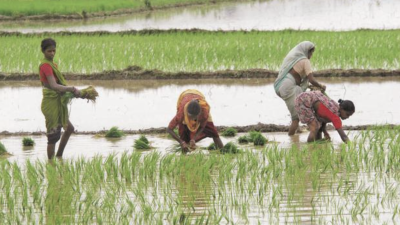
The India Meteorological Department (IMD) forecasted a below-normal southwest monsoon for 2024. The monsoon rainfall is expected to be 92% of the Long Period Average (LPA) with a model error margin of ±4%. The forecast was issued in April 2024, covering the June to September period.
Monsoon Rainfall Distribution
The IMD projected deficient rainfall over central and western India. Normal to excess rainfall is expected in the northeastern states and parts of eastern India. The spatial variability is likely to affect agricultural zones differently across regions.
Factors Influencing the Monsoon
The forecast considered the weakening of El Niño-Southern Oscillation (ENSO) effects and the presence of a warm Indian Ocean. The delayed onset of the monsoon over Kerala was also noted. Sea surface temperatures and atmospheric circulation patterns were key variables in the model.
Implications for Agriculture and Economy
Below-normal rainfall may impact kharif crop production, especially cereals such as rice and maize. The IMD forecast raised concerns about food inflation due to potential supply constraints. States dependent on monsoon for irrigation may face water shortages affecting crop yields.
Government and Institutional Responses
The Ministry of Agriculture and Farmers Welfare has been advised to prepare contingency plans. Steps include promoting drought-resistant crop varieties and enhancing water conservation. The IMD will issue periodic updates to monitor monsoon progress.
What to Study for UPSC Exams?
- Monsoon Mechanisms and Variability
- El Niño and La Niña Effects
- Indian Agricultural Seasons
- Food Inflation and Supply Chain
Monsoon Mechanisms and Variability
The southwest monsoon is driven by differential heating between the Indian Ocean and the Asian landmass. The monsoon onset typically begins in early June over Kerala. Variability arises from factors like the Tibetan Plateau heating, land-sea temperature gradients, and large-scale atmospheric circulation changes.
El Niño and La Niña Effects
El Niño is characterized by warming of the central and eastern Pacific Ocean, often causing deficient Indian monsoon rainfall. La Niña involves cooling of the same region and usually enhances monsoon strength. Both phenomena influence global weather patterns via atmospheric teleconnections.
Indian Agricultural Seasons
India has three main agricultural seasons: Kharif (monsoon crops), Rabi (winter crops), and Zaid (summer crops). Kharif crops like rice and maize depend heavily on monsoon rains. Rabi crops such as wheat rely on irrigation and residual soil moisture.
Food Inflation and Supply Chain
Food inflation is influenced by crop yields, storage infrastructure, and distribution efficiency. Supply chains in India face challenges like post-harvest losses and fragmented markets. Price volatility often correlates with monsoon variability affecting production and transportation.
Last Modified: April 14, 2026