
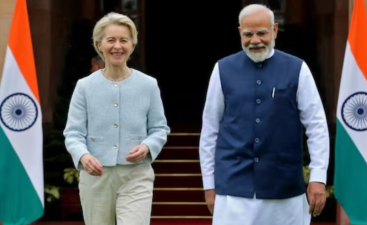
German Chancellor Friedrich Merz’s high-profile outreach to Prime Minister Narendra Modi — complete with symbolic kite-flying, defence cooperation announcements and visa-free transit for Indian travellers — has rekindled hopes that the long-stalled India–EU free trade agreement (FTA) may finally be within reach. With the India–EU Summit less than two weeks away, the moment appears unusually propitious, especially as global trade winds turn increasingly hostile.
Why the Germany signal matters
For over a decade, negotiations on an India–EU FTA have remained stuck over disagreements on environmental standards, labour rights and regulatory norms. That Berlin is now visibly pushing engagement suggests a strategic recalibration within Europe. Germany, the EU’s economic engine, appears keen to deepen ties with India at a time when relations with both the US and China are becoming more fraught.
Merz’s engagement with Narendra Modi therefore goes beyond symbolism. It hints at political momentum that could help overcome long-standing deadlocks in Brussels.
The global backdrop: turbulence in the US economy
The broader context for India’s trade strategy in 2026 is being shaped by developments in the world’s two largest economies. The US economy ended 2025 with strong headline growth — 4.3 per cent in the third quarter — driven largely by consumption. However, the foundations of this growth appear fragile.
Investment is heavily concentrated in artificial intelligence infrastructure, corporate hiring has stalled, and AI-linked stocks show stretched valuations. Consumption growth is skewed towards higher-income households and may weaken as proposed tax cuts under President Donald Trump add to public debt or are financed through higher tariffs. Past experience with “reciprocal tariffs” suggests such measures eventually stoke inflation, suppress demand, and undermine growth itself.
China’s slowdown and its global spillovers
If the US outlook is uncertain, China’s is structurally constrained. Long-term growth has slowed steadily — from 8–10 per cent in the decades after 1980 to around 5 per cent in 2024–25, with projections drifting closer to 4 per cent. A prolonged real estate crisis and ageing demographics continue to depress domestic demand.
China’s recent export surge offers limited comfort for global trade. Much of it reflects trade diversion away from the US towards developing economies, many of which are now raising tariff and non-tariff barriers. Another channel — routing exports indirectly through countries like Mexico and Vietnam — is already under pressure as the US moves to block such arbitrage.
Why traditional trade engines look weak for India
Against this backdrop, India’s conventional global trade prospects in 2026 appear constrained. Services exports linked to the US economy may show some resilience, but the late-2025 uptick in commodity trade was largely driven by pre-emptive buying ahead of Trump’s tariff regime.
This leaves trade diversion away from the US as the main avenue for expansion — and here, regional trade agreements become critical. The recently concluded India–UK deal and the prospective India–EU pact thus acquire heightened strategic significance.
Europe’s recalibration and India’s opportunity
Amid intense focus on US policy shifts, the importance of Europe in India’s trade matrix is often overlooked. The EU is India’s fourth-largest trading partner, with cumulative foreign direct investment of around $120 billion by 2024.
Europe’s own anxieties — ranging from transatlantic frictions to tensions over Chinese trade — are pushing it to diversify partnerships. Skilled migration is emerging as a key area of reassessment. Germany’s Skilled Immigration Act, which already provides quotas for Indian professionals, points to a new willingness to discuss mobility.
This creates an opening for India to push for greater movement of skilled persons — known as Mode 4 in WTO terminology — as part of an India–EU trade agreement, something that was politically unthinkable earlier.
Germany as the gateway to a broader deal
Germany’s dominance within EU trade and manufacturing makes it a natural anchor for a wider India–EU agreement. An expanded pact could go beyond tariffs to include services, investment protection and technology cooperation. This matters because foreign direct investment remains the most durable channel for technology transfer, and evidence consistently shows that trade and FDI reinforce each other.
Priority sectors such as electronics, green technologies and infrastructure align closely with both India’s development needs and Germany’s industrial strengths.
From FTAs to tangible gains
India’s recent rush to sign FTAs has often been questioned, but the emerging pattern suggests a deliberate response to a fragmenting global trade order. The challenge now is to translate agreements into real economic gains.
If talks with Germany catalyse a meaningful India–EU FTA — one that foregrounds services trade, Mode 4 mobility and a robust investment framework — it could mark a genuine reset in India’s external economic strategy. In an uncertain global economy, that would indeed be a promising new beginning.
What to note for Prelims?
- Status and significance of the India–EU FTA negotiations
- Germany’s role within the European Union economy
- Concept of Mode 4 (movement of natural persons) in WTO
- India’s major trading partners and FDI sources
What to note for Mains?
- Analyse why regional trade agreements are gaining importance amid global protectionism
- Discuss the strategic and economic significance of an India–EU FTA
- Examine how services trade and skilled migration can reshape India’s trade diplomacy
- Evaluate the role of FDI in technology transfer and long-term growth