
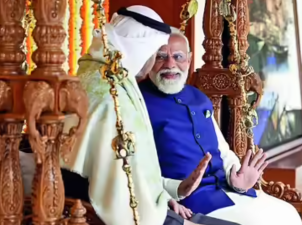
The brief but consequential visit of UAE President Sheikh Mohamed bin Zayed Al Nahyan to New Delhi has underscored a quiet but significant shift in India’s West Asia strategy. While the optics suggested a tightly choreographed engagement — a single meeting with Prime Minister Narendra Modi — the outcomes point to a deepening partnership that now extends beyond economics into the sensitive domain of defence cooperation, at a time when the Gulf and its neighbourhood are marked by growing instability.
A partnership anchored in economics, now stretching further
The United Arab Emirates today occupies a central place in India’s external economic engagements. It is India’s third-largest trading partner, second-largest export destination, and among the top foreign investors. The two countries also signed India’s first bilateral comprehensive trade agreement in 2022, signalling mutual confidence in long-term economic integration.
The announcements during the visit reinforced this trajectory: a shared commitment to double bilateral trade to $200 billion, a $3 billion LNG agreement, and fresh UAE investments in Gujarat. These decisions consolidate the UAE’s role as a critical economic partner at a time when India is seeking reliable markets, energy security, and investment flows.
The significance of a proposed strategic defence partnership
The most consequential outcome, however, was the decision to work towards a framework agreement on an India–UAE “Strategic Defence Partnership” — the first of its kind for New Delhi. While details remain sparse, the signal is unmistakable: India is willing to institutionalise defence cooperation with a key Gulf power.
For West Asia and South Asia alike, this announcement carries weight. Defence arrangements in the Gulf are rarely viewed in isolation, given the dense web of rivalries, alliances, and proxy conflicts. Even if Indian officials emphasise that the agreement is not aimed at any hypothetical military contingency, its strategic implications will inevitably be interpreted through a regional lens.
Gulf rivalries and the backdrop of MbZ’s visit
The timing of the visit is as significant as its content. It comes amid worsening tensions between the UAE and Saudi Arabia, once close partners in the coalition against the Houthi uprising in 2014. Their rivalry has sharpened over competing interests in Sudan and divergent regional ambitions, with the absence of direct communication between Sheikh Mohamed bin Zayed Al Nahyan and Saudi Crown Prince Mohammed bin Salman now described as the Gulf’s new “cold war”.
This evolving power struggle has fragmented what was once a more cohesive Gulf security architecture, complicating the strategic environment for external partners like India.
A region unsettled on multiple fronts
Beyond Gulf rivalries, West Asia is witnessing layered instability. Protests and unrest in Iran, coupled with U.S. threats of intervention, have added to regional volatility. The Gaza ceasefire remains fragile, and U.S. President Donald Trump’s proposals for a “Board of Peace” have generated more uncertainty than reassurance.
The security picture darkened further after Israel’s bombing in Qatar in September 2025, prompting Saudi Arabia to fast-track a “mutual defence pact” with Pakistan and reportedly explore Türkiye’s inclusion. These developments point to the emergence of overlapping security arrangements that could redraw regional alignments — often without regard for Indian interests.
India’s diplomatic balancing act in West Asia
For New Delhi, the challenge lies in deepening ties with the UAE without unsettling relations with other key Gulf partners. Nearly 10 million Indians live and work across the Gulf Cooperation Council countries, making regional stability and balanced diplomacy an economic and social imperative.
The Gulf remains India’s most important energy source, particularly as U.S. and European sanctions have restricted access to other suppliers. Any perception of India aligning militarily with one regional actor could complicate these vital relationships.
Connectivity ambitions under strain
India’s long-term strategic vision for Eurasian and West Asian connectivity is also at stake. Projects such as the Chabahar port in Iran, the International North South Transport Corridor, and the India–Middle East–Europe Economic Corridor depend on cooperation across multiple faultlines. Escalating tensions among regional players threaten to undermine these initiatives, which are central to India’s trade diversification and strategic autonomy.
What to note for Prelims?
- India–UAE Comprehensive Economic Partnership Agreement (2022).
- Strategic importance of the Gulf Cooperation Council region for India.
- Key regional connectivity projects involving India.
- Major faultlines in contemporary West Asian geopolitics.
What to note for Mains?
- Strategic implications of India expanding defence ties in West Asia.
- Challenges of balancing relations amid Gulf rivalries.
- Energy security, diaspora interests, and regional instability.
- Impact of West Asian conflicts on India’s connectivity and foreign policy goals.