
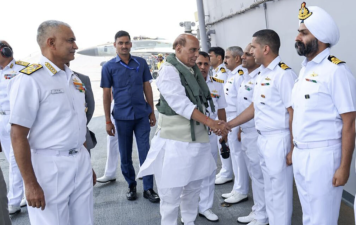
The Indian Navy held its annual Commanders’ Conference in New Delhi from April 24 to 26, 2024. The conference was chaired by the Chief of Naval Staff, Admiral R. Hari Kumar. Concurrently, GE Aerospace signed a contract with the Indian Air Force (IAF) for the supply of advanced aircraft engines worth $1.2 billion.
Indian Navy Commanders’ Conference
The conference focused on operational readiness, force modernisation, and maritime security. Discussions included deployment strategies in the Indo-Pacific region and integration of new platforms like the P-8I maritime patrol aircraft. The Navy reviewed joint exercises with foreign navies and plans to enhance coastal surveillance using indigenous technology. Cybersecurity and space-based maritime domain awareness were key agenda points.
GE Aerospace-IAF Engine Supply Deal
GE Aerospace committed to supplying 200 F414-GE-INS6 engines for the IAF’s Tejas Mark 1A fighter jets. The deal includes maintenance support and technology transfer components. The contract aims to boost the indigenous fighter programme’s production capacity and reduce dependence on foreign suppliers. Delivery is scheduled between 2025 and 2030.
Strategic Significance of Both Events
The Navy’s conference emphasised jointness with the Indian Army and Air Force for integrated defence. The GE-IAF deal aligns with India’s Atmanirbhar Bharat initiative in defence manufacturing. Both developments contribute to India’s broader military modernisation and regional security posture.
Future Plans and Implementation
The Navy plans to commission new warships and expand submarine capabilities by 2026. The IAF will enhance its fighter fleet through the Tejas programme, supported by GE’s engine supply. Both services will increase investments in indigenous research and development projects.
What to Study for UPSC Exams?
- Indigenous Defence Production
- Maritime Security Mechanisms
- Military Modernisation Programmes
- Defence Technology Transfer Policies
Indigenous Defence Production
India’s indigenous defence production includes platforms like the Tejas fighter jet and the Arihant-class nuclear submarines. Defence Public Sector Undertakings (DPSUs) and private firms collaborate under the Defence Procurement Procedure. The Defence Research and Development Organisation (DRDO) leads R&D, focusing on self-reliance and reducing imports, with initiatives like Atmanirbhar Bharat boosting local manufacturing.
Maritime Security Mechanisms
Maritime security mechanisms involve coastal radar chains, naval patrols, and international cooperation for anti-piracy. India operates the Information Fusion Centre for the Indian Ocean Region (IFC-IOR) for intelligence sharing. Space-based maritime domain awareness and underwater sensor networks enhance surveillance over vast oceanic areas.
Military Modernisation Programmes
Military modernisation includes upgrading weapons, platforms, and digital warfare capabilities. India’s Defence Acquisition Council oversees procurement plans like the Project 75I submarine and Tejas Mark 1A fighter jets. Emphasis is on network-centric warfare, indigenous systems, and integrating AI and robotics into military operations.
Defence Technology Transfer Policies
Defence technology transfer in India is governed by the Defence Production Policy and foreign direct investment norms. It aims to facilitate local manufacturing through licensing, joint ventures, and offsets. The policy encourages collaboration with global OEMs to enhance domestic capabilities and reduce import dependency.
Last Modified: April 13, 2026