
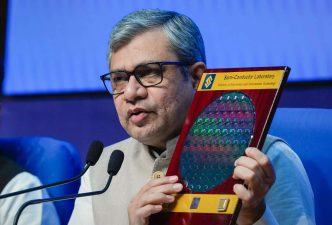
In recent developments, India is set to unveil its first ‘Made-in-India’ semiconductor chip by September or October 2025. Minister of Information and Broadcasting Ashwini Vaishnaw announced this milestone during a media briefing in Bengaluru. The Government of India is investing in semiconductor technology, particularly in gallium nitride (GaN), which is essential for telecommunications and power applications.
Government Investment and Support
The Government of India has allocated Rs 334 crore to the Indian Institute of Science (IISc), Bengaluru, for research and development in GaN technology. This investment aims to enhance India’s capabilities in semiconductor manufacturing. A production-linked incentive scheme will also be introduced to encourage local production of semiconductor components.
Semiconductor Manufacturing Initiatives
Tata Electronics, in collaboration with Powerchip Semiconductor Manufacturing Corporation (PSMC), is establishing India’s first semiconductor fabrication plant in Dholera, Gujarat. This initiative marks step towards building a robust semiconductor ecosystem in India. The plant is expected to play important role in meeting domestic semiconductor demands.
Technological Advancements at IISc
The IISc has made notable advancements by developing India’s first e-mode gallium nitride power transistor. This innovation demonstrates performance capabilities that rival some of the best existing technologies. Such breakthroughs position India as a competitive player in the global semiconductor market.
Semicon India Programme
Launched in December 2021, the Semicon India programme has a total outlay of Rs 76,000 crore. This initiative aims to boost the semiconductor and display manufacturing ecosystem in India. It provides financial support to companies investing in semiconductor technology and aims to create a sustainable environment for semiconductor design and manufacturing.
India Semiconductor Mission
The India Semiconductor Mission (ISM) operates as an independent division within the Digital India Corporation. It has the authority to develop long-term strategies for semiconductor manufacturing and design. This mission is crucial for achieving self-sufficiency in semiconductor production.
Market Projections
India’s semiconductor market is projected to reach $63 billion by 2026. This growth is driven by increasing demand for electronic devices and advancements in technology. The government’s support and initiatives are expected to facilitate this growth and position India as a key player in the global semiconductor landscape.
Future Outlook
The launch of the first Made-in-India chip signifies a very important moment for India’s technological advancement. With ongoing investments and strategic initiatives, India is poised to establish a comprehensive semiconductor manufacturing ecosystem. This development will not only enhance domestic capabilities but also contribute to global semiconductor supply chains.
Questions for UPSC:
- Examine the impact of semiconductor technology on India’s economic growth.
- Critically discuss the significance of the Semicon India programme in promoting indigenous manufacturing.
- Estimate the potential challenges India may face in establishing a semiconductor ecosystem.
- Analyse the role of gallium nitride technology in modern electronic applications.
Answer Hints:
1. Examine the impact of semiconductor technology on India’s economic growth.
- Semiconductors are crucial for electronics, automotive, and telecommunications sectors, driving innovation.
- Local manufacturing can reduce dependency on imports, improving trade balance and creating jobs.
- Investment in semiconductor technology can attract foreign direct investment (FDI), boosting the economy.
- Development of a robust semiconductor ecosystem can enhance research and development capabilities in India.
- Growth in the semiconductor market can contribute to GDP, projected to reach $63 billion by 2026.
2. Critically discuss the significance of the Semicon India programme in promoting indigenous manufacturing.
- The programme allocates Rs 76,000 crore to support semiconductor and display manufacturing in India.
- It aims to create a sustainable ecosystem, encouraging local production and reducing import dependency.
- Financial incentives are provided to attract investments from both domestic and international companies.
- It encourages innovation and technology transfer, enhancing local expertise in semiconductor design and manufacturing.
- The initiative aims to position India as a global hub for semiconductor production, increasing competitiveness.
3. Estimate the potential challenges India may face in establishing a semiconductor ecosystem.
- High initial capital investment and operational costs can deter new entrants into the semiconductor market.
- Skilled workforce shortages may hinder the development and operation of semiconductor manufacturing facilities.
- Global supply chain disruptions can impact the procurement of essential materials and components.
- Intense competition from established semiconductor markets like the USA, Taiwan, and South Korea poses a challenge.
- Regulatory hurdles and bureaucratic processes can slow down the implementation of semiconductor projects.
4. Analyse the role of gallium nitride technology in modern electronic applications.
- GaN is essential for high-efficiency power electronics, improving performance in telecommunications and power systems.
- It enables smaller, lighter electronic devices with higher power density compared to traditional silicon-based technologies.
- GaN technology supports faster charging solutions in electric vehicles and consumer electronics.
- It is crucial for renewable energy applications, enhancing the efficiency of solar inverters and power converters.
- Research and development in GaN can position India competitively in the global semiconductor market.