
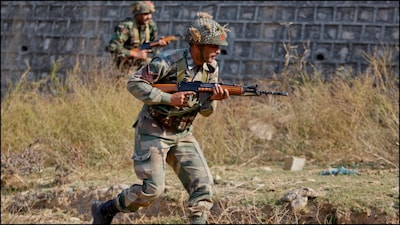
India is rapidly transforming its armed forces to meet evolving multi-domain threats. The rise of artificial intelligence, drones, automation, and precision weapons has changed warfighting dynamics. Facing two-front challenges from China and Pakistan, India is reshaping its military structure, doctrine, technology, and training to enhance jointness and operational readiness.
Shift From Coordination to Command
India aims to move beyond mere coordination among its Army, Navy, and Air Force towards integrated theatre commands. Prime Minister Narendra Modi brought into light this shift at the 2025 Combined Commanders Conference. The Defence Ministry is revising rules to empower commanders with disciplinary and administrative authority for joint operations. However, progress has been slow and must accelerate to meet current threats. Tri-service agencies for cyber, space, and special operations now operate under the Integrated Defence Staff. New modular combat units like Rudra and Bhairav combine multiple arms for faster, flexible responses along hostile borders.
Doctrine and Technology Evolution
India’s Joint Doctrine (2017) and Army Land Warfare Doctrine (2018) lay the foundation for synergy. The recent Ran Samvad seminar focused on future hybrid warriors skilled in technology, information, and strategy. Future wars will be multi-domain, where speed and information matter as much as firepower. Procurement aligns with this vision – MQ-9B drones enhance persistent surveillance and precision strikes across land and sea. Rafale-M jets boost carrier aviation and maritime strike capabilities. The Akashteer AI-enabled air defence network integrates Army and Air Force systems, advancing joint command and control.
Modernising Force Composition
The Army’s Integrated Battle Groups, such as Rudra, are all-arms brigades with armour, infantry, artillery, engineers, drones, and loitering munitions. These units can deploy rapidly within 12 to 48 hours tailored to specific theatres. The Pralay quasi-ballistic missile strengthens land-based strike power. At sea, India is building a carrier-centric naval posture supported by Rafale-M jets and a 15-year roadmap for air, subsurface, and unmanned capabilities. Joint training, logistics, and firepower integration remain critical for operational success.
Professional Military Education and Civil-Military Fusion
Jointness requires technologist-commanders trained in all domains. Professional Military Education (PME) now emphasises technology, coding, and rapid adaptation. Embedding defence research, industry, and academia into PME and exercises encourages innovation and rapid prototyping. Civil-military fusion links the Defence Research and Development Organisation, public and private sectors, and universities to create a continuous cycle of testing and upgrading capabilities. This approach ensures that only effective technologies and doctrines persist on the battlefield.
Indigenous Theatre Command Design
Unlike China’s established integrated theatre commands, India is developing an indigenous model suited to its strategic context. Theatre commands will gradually assume broader authority, tested through initial mandates. This design aims to overcome inter-service rivalry and improve joint operational effectiveness. The true test of jointness will come with complex multi-domain operations, beyond recent aerial confrontations like Operation Sindoor.
Future Outlook
India’s military reforms focus on speed, flexibility, and integration across domains. The transformation from service silos to joint commands, backed by advanced technology and education, aims to prepare India for future warfare. The evolving doctrines and force structures reflect the need for an adaptive military that can meet the challenges of modern conflict.
Questions for UPSC:
- Point out the significance of integrated theatre commands in enhancing India’s defence capabilities and how they differ from traditional service structures.
- Critically analyse the role of artificial intelligence and automation in modern warfare with suitable examples from global military developments.
- Estimate the challenges and benefits of civil-military fusion in defence technology development and its impact on national security.
- What are hybrid warriors? How can professional military education evolve to prepare armed forces for multi-domain warfare?