
As 2026 begins, the global order looks less like a stable system and more like a field of shifting fault lines. Geopolitical tensions, weaponised trade, artificial intelligence–driven disruptions, and climate stress are colliding in ways that have made interdependence unavoidable but trust increasingly scarce. For India, this turbulence has not merely posed risks; it has tested — and largely validated — New Delhi’s strategy of multi-alignment in a fragmented world.
A world of interdependence without trust
The defining feature of the current global phase is paradoxical. Economies, supply chains, and technologies are more deeply intertwined than ever, yet political trust is at its lowest in decades. Partnerships have grown transactional, economic ties are increasingly used as tools of coercion, and long-held strategic assumptions no longer hold automatically.
From New Delhi’s vantage point, 2025 demonstrated that this is an era of “weaponised interdependence” — where market access, supply chains, and tariffs can be deployed with strategic intent. India’s challenge has been to remain globally engaged without becoming strategically vulnerable.
Supply chains as the new battleground
The most disruptive shocks of 2025 came not from conventional military conflict, but from economic choke points. When restricted exports of critical rare-earth minerals, the move sent tremors through global clean-energy and electric-vehicle supply chains, directly affecting India’s green transition ambitions.
Similarly, the imposition of steep tariffs by the United States under President Donald Trump sharply reduced market access for India’s labour-intensive exports. These episodes underscored how deeply trade and technology have become instruments of geopolitical leverage.
India’s response: strategic autonomy through resilience
India’s reaction marked a shift from reactive diplomacy to proactive resilience-building. Rather than retreating from globalisation, New Delhi diversified it. Negotiations on free trade agreements were accelerated with partners ranging from the UK and the EU to New Zealand and Oman.
At the same time, India fast-tracked the National Critical Mineral Mission and deepened cooperation under the Mineral Security Partnership with countries such as the US and Australia. The message was clear: in today’s world, strategic autonomy is inseparable from supply-chain security.
Economic reforms amid global uncertainty
Economically, 2025 was a year of contrasts. External shocks and protectionist rhetoric put pressure on the rupee, raising concerns over imported inflation — especially energy costs. Yet domestic fundamentals remained relatively strong, supported by a stable fiscal trajectory and a renewed reform push.
The enactment of long-pending labour codes and the SHANTI Act to open nuclear energy to private investment signalled a shift toward building a more shock-resistant, internally driven growth model. Even as the International Monetary Fund revised India’s $5-trillion economy timeline, India’s emergence as the world’s fourth-largest economy reflected a sustained phase of structural reform rather than short-term momentum.
Diplomacy beyond binaries
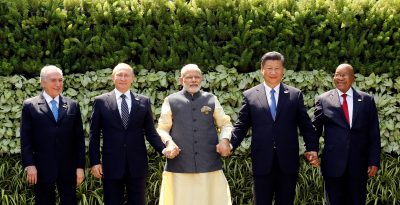
India’s diplomatic calendar reinforced its refusal to choose sides in a polarised world. New Delhi balanced deepening ties with the Global South while maintaining working relationships with Washington, Moscow, and Beijing. High-level engagements — including outreach to Russia despite Western pressure — asserted India’s sovereign decision-making.
Simultaneously, partnerships in the Indo-Pacific were strengthened through platforms such as the India-Japan summit and new maritime exercises with African nations, positioning India as a bridge-builder rather than a bloc-follower.
Climate leadership with development realism
Climate diplomacy added another layer to India’s global positioning. At , India projected itself as a leading voice of the Global South, pressing developed countries to move beyond pledges to predictable financial and technological support.
Through initiatives like the International Solar Alliance, India advanced clean-energy cooperation, even as it navigated the domestic reality of continued coal dependence. This balancing act reflected a broader tension between developmental imperatives and sustainability goals.
The digital frontier and India’s tech diplomacy
Perhaps the most distinctive strand of India’s global strategy has emerged in the digital domain. As the internet fragments into sovereign “digital blocs,” India has positioned its digital public infrastructure as a global public good. By exporting the India Stack and linking payment systems like with partner countries, India is offering an open, transparent alternative to closed digital ecosystems.
In a low-trust world, this form of tech diplomacy has become a powerful tool for building influence without coercion.
AI, jobs, and inclusive growth
Artificial intelligence has added urgency to domestic policy challenges. While automation threatens low-skill employment, India’s large IT workforce and digital infrastructure provide an opportunity to lead in AI innovation. The real test lies in managing this transition equitably — investing in reskilling, education, and digital inclusion to prevent a widening socio-economic divide.
What to note for Prelims?
- Concept of multi-alignment in Indian foreign policy.
- National Critical Mineral Mission and Mineral Security Partnership.
- India Stack and UPI as digital public infrastructure exports.
- Role of International Solar Alliance.
What to note for Mains?
- Weaponised interdependence and its impact on developing economies.
- India’s strategy of strategic autonomy through supply-chain resilience.
- Balancing climate leadership with developmental needs.
- Tech diplomacy as a tool of soft power in a fragmented digital order.