
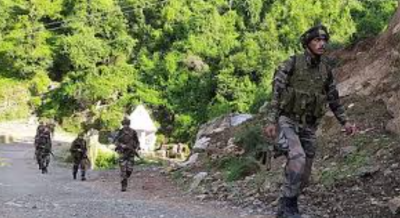
Recent security operations in October 2025 marked escalation in India’s efforts to combat insurgent groups operating from across the Myanmar border. The Indian Army and Assam Rifles launched coordinated actions targeting terrorist camps in Myanmar linked to the National Socialist Council of Nagaland (NSCN-Khaplang Yung Aung group) and the United Liberation Front of Asom (ULFA-I). These operations involved ground ambushes and precise drone strikes aimed at dismantling militant leadership and disrupting their networks.
Cross-Border Military Operations
On the nights of October 21 and 22, 2025, Indian forces engaged terrorists at 6th Mile Camp in Arunachal Pradesh’s Namsai district. This followed a drone strike on October 19 targeting NSCN-KY camps inside Myanmar. The strike eliminated five militants, including key commander Major General Peyong Konyak, implicated in recent attacks on Assam Rifles bases. These actions were a direct response to militant assaults on Indian security posts in Arunachal Pradesh and Assam earlier that month.
Militant Attacks and Indian Countermeasures
Earlier in October, NSCN-KY and ULFA-I militants launched attacks on Assam Rifles and Army bases along the Indo-Myanmar border. On October 16, NSCN-KY militants attacked a company operating base in Changlang district. ULFA-I cadres attacked an Army base in Tinsukia district on October 16 and attempted another assault the following day. Indian forces responded swiftly, inflicting casualties and arresting an overground worker aiding the militants. These events triggered intensified counter-insurgency operations supported by drones, intelligence teams, and modern surveillance.
Disruption of Terrorist Networks
The October operations led to the neutralisation of militants and recovery of weapons and warlike stores. The death of ULFA-I’s self-styled Sergeant Major Iwon Axom and seizure of arms weakened the group’s operational capacity. The combined use of ground ambushes and drone strikes demonstrated India’s enhanced tactical capabilities. These efforts disrupted militant logistics and leadership, forcing insurgent groups to retreat and regroup.
Geopolitical Context and External Influences
The resurgence of militant attacks shortly after Operation Sindoor in May 2025 is linked to external interference. Pakistan’s military leadership reportedly threatened eastern attacks following setbacks in western theatres. The Inter-Services Intelligence (ISI) is believed to have revived contacts with Northeast insurgent groups to destabilise India’s border regions. Historical ties between ISI and insurgent groups like ULFA and NSCN date back to the 1990s, facilitated by Bangladesh’s political landscape at the time. Renewed ISI activity, possibly in collaboration with foreign agencies, complicates regional security dynamics.
Intelligence and Regional Security Challenges
The presence of foreign operatives and intelligence agencies in Bangladesh and neighbouring areas adds layers of complexity. The mysterious death of a senior US Army officer in Dhaka in August 2025 raised concerns over covert activities in the region. Although official statements remain scarce, security forces across Northeast India and border states have heightened vigilance. The evolving threat environment demands sustained intelligence sharing and coordinated responses among India, Myanmar, and neighbouring countries.
Questions for UPSC:
- Critically discuss the role of cross-border insurgency in India’s Northeast and the challenges it poses to national security.
- Analyse the impact of foreign intelligence agencies on insurgent movements in South Asia and their implications for regional stability.
- Examine the evolution of counter-insurgency tactics in India with reference to the use of drones and intelligence-based operations.
- Estimate the strategic significance of the India-Myanmar border in combating terrorism and maintaining bilateral relations.
Answer Hints:
1. Critically discuss the role of cross-border insurgency in India’s Northeast and the challenges it poses to national security.
- Insurgent groups like ULFA (I) and NSCN (K) operate from safe havens across the Myanmar border, enabling sustained attacks in Northeast India.
- Cross-border sanctuaries complicate Indian security forces’ ability to eliminate militants due to sovereignty and diplomatic constraints.
- Frequent militant attacks on Assam Rifles and Army bases destabilize border districts and disrupt local governance and development.
- Insurgents exploit difficult terrain and porous borders to evade capture and regroup, prolonging conflict cycles.
- Cross-border insurgency facilitates smuggling of arms, logistics, and recruitment across international boundaries.
- It necessitates coordinated bilateral operations and intelligence-sharing between India and Myanmar, which faces its own internal challenges.
2. Analyse the impact of foreign intelligence agencies on insurgent movements in South Asia and their implications for regional stability.
- Agencies like Pakistan’s ISI have historically supported Northeast insurgents (ULFA, NSCN) to destabilize India’s border regions.
- ISI’s involvement includes training, arming, and facilitating safe passage through Bangladesh and Myanmar, enhancing insurgent capabilities.
- Such external backing transforms local insurgencies into proxy conflicts, increasing violence and complicating peace efforts.
- Collaboration with other foreign operatives, including suspected US intelligence presence, adds complexity to regional security dynamics.
- Foreign interference undermines sovereignty, fuels mistrust among South Asian nations, and impedes cooperative counter-terrorism.
- It risks spillover effects, including cross-border terrorism, refugee flows, and diplomatic tensions affecting bilateral relations.
3. Examine the evolution of counter-insurgency tactics in India with reference to the use of drones and intelligence-based operations.
- Traditional ground ambushes and search operations have been supplemented with precision drone strikes targeting militant leadership and camps.
- Integration of modern surveillance assets and high-tech intelligence teams enhances real-time situational awareness and operational planning.
- Drone strikes enable cross-border targeting without large-scale troop deployment, reducing risk to Indian forces and collateral damage.
- Intelligence-driven operations allow rapid response to militant attacks and disruption of insurgent logistics and networks.
- Use of drones and tech assets reflects a shift towards surgical, technology-enabled counter-terrorism in difficult terrains.
- These tactics improve morale and operational effectiveness of security forces, forcing insurgents into retreat and disarray.
4. Estimate the strategic significance of the India-Myanmar border in combating terrorism and maintaining bilateral relations.
- The India-Myanmar border is a critical front for counter-insurgency, as many Northeast insurgents use Myanmar as a safe haven.
- Effective border management and joint operations help curb cross-border militant movement and arms smuggling.
- Cooperation with Myanmar is essential for intelligence sharing, coordinated strikes, and maintaining regional stability.
- The border region’s stability impacts trade, connectivity projects (like the India-Myanmar-Thailand Trilateral Highway), and economic development.
- Bilateral relations are strengthened through security collaboration, contributing to broader geopolitical balance in Southeast Asia.
- Instability along the border risks spillover of insurgency, affecting India’s internal security and Myanmar’s own ethnic conflicts.