
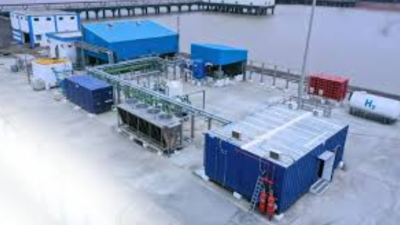
India’s ports are rapidly emerging as very important centres for the green hydrogen economy. The government has identified Deendayal Port (Gujarat), Paradip Port (Odisha), and VO Chidambaranar Port (Tamil Nadu) as key green hydrogen hubs. These ports are set to transform the national and global maritime and energy sectors. Industry investments exceeding ₹1.5 lakh crore signal strong confidence in this shift. Recent market trends show India’s competitive edge in producing green e-fuels such as ammonia and methanol at lower costs than global peers.
Strategic Designation of Green Hydrogen Hubs
The three designated ports have been allocated nearly 4,500 acres for green hydrogen activities. This includes production, storage, bunkering, and refuelling infrastructure. Their locations near industrial clusters and established maritime infrastructure offer logistical advantages. The government’s focus on these hubs aims to integrate ports into the green hydrogen value chain, moving beyond traditional trade functions.
Cost Competitiveness and Market Signals
India’s green ammonia prices discovered through the Solar Energy Corporation of India (SECI) tender averaged around $600 per tonne. This price is nearly 45% lower than similar auctions in countries like Germany. Such cost efficiency sets new international benchmarks for green ammonia and signals potential for green methanol. Subsidies on electricity and capital costs reduce production expenses by up to 40%, reinforcing India’s global competitiveness.
Infrastructure and Collaborative Models
Ports like VO Chidambaranar and Jawaharlal Nehru Port already handle volumes of ammonia and methanol. These ports can leverage existing storage and handling infrastructure to accelerate green hydrogen adoption. A hub-based model supported by public-private partnerships is seen as pragmatic. Common User Infrastructure (CUI) systems allow sharing of pipelines, storage, and desalinated water facilities. This reduces redundant investment and encourages collaborative growth with revenue-sharing mechanisms.
Emerging Business Models and Ecosystems
Ports can adopt innovative business models such as energy-as-a-service by leasing land and infrastructure to hydrogen producers. Performance-based revenue sharing incentivises efficiency and growth. Additionally, ports can become innovation zones by anchoring green industrial clusters. This creates circular demand ecosystems for green hydrogen derivatives in sectors like fertilisers, steel, and shipping.
Addressing Challenges and Future Opportunities
A major challenge is the lack of credible hydrogen offtake agreements globally. Indian ports can mitigate this by establishing green shipping corridors. These are shipping routes optimised for zero-emission fuels, boosting demand for green hydrogen. This green supply chain model complements India’s cost advantages and can position the country as Asia’s gateway for green shipping fleets.
Questions for UPSC:
- Taking example of India’s green hydrogen port hubs, discuss the role of infrastructure development in achieving energy transition goals.
- Examine the impact of government subsidies on promoting renewable energy industries and analyse their long-term sustainability.
- With suitable examples, discuss the significance of public-private partnerships in advancing green technologies and industrial growth.
- Critically discuss the challenges and opportunities in establishing green shipping corridors and their potential influence on global maritime trade.
Answer Hints:
1. Taking example of India’s green hydrogen port hubs, discuss the role of infrastructure development in achieving energy transition goals.
- Designated ports (Deendayal, Paradip, VOC) allocated ~4,500 acres for green hydrogen production, storage, bunkering, and refuelling.
- Proximity to industrial clusters and established maritime infrastructure enhances logistics and supply chain efficiency.
- Existing ammonia and methanol handling infrastructure at ports like VOC and Jawaharlal Nehru Port accelerates green hydrogen adoption.
- Common User Infrastructure (CUI) models reduce redundant capital expenditure by sharing pipelines, storage, and utilities.
- Infrastructure enables integration of production, storage, distribution, and demand facilitation, transforming ports into green hydrogen hubs.
- Robust infrastructure is critical for scaling green hydrogen value chains and meeting national energy transition targets.
2. Examine the impact of government subsidies on promoting renewable energy industries and analyse their long-term sustainability.
- Subsidies like electricity charge waivers and capital support reduce green ammonia production costs by nearly 40%.
- Lower production costs enable India to offer green hydrogen derivatives at prices competitive with or below global benchmarks.
- Subsidies attract investments (₹1.5 lakh crore) across the green hydrogen value chain.
- Dependence on subsidies raises concerns about market distortions and long-term financial sustainability.
- Gradual subsidy phase-out and creating credible demand through offtake agreements are essential for sustainable growth.
- Subsidies act as a critical catalyst initially, but innovation and economies of scale must drive future competitiveness.
3. With suitable examples, discuss the significance of public-private partnerships in advancing green technologies and industrial growth.
- Hub-based models at Indian ports leverage public-private collaboration for infrastructure development and operational efficiency.
- Shared infrastructure (pipelines, storage, desalinated water) under Common User Infrastructure (CUI) reduces costs and encourages private investment.
- Energy-as-a-service models involve leasing port land and infrastructure to hydrogen producers with performance-based revenue sharing.
- Public-private partnerships enable risk sharing, innovation, and faster deployment of green hydrogen technologies.
- Examples include investments in Deendayal, Paradip, and VOC ports, attracting ₹1.5 lakh crore industry commitments.
- Such partnerships encourage creation of green industrial clusters, stimulating circular demand ecosystems for green fuels.
4. Critically discuss the challenges and opportunities in establishing green shipping corridors and their potential influence on global maritime trade.
- Green shipping corridors optimize maritime routes for zero-emission fuels, reducing carbon footprint of shipping industry.
- They create credible demand for green hydrogen and derivatives, addressing global offtake challenges.
- Indian ports can become Asia’s gateway for green shipping fleets, leveraging cost competitiveness and infrastructure.
- Challenges include infrastructure readiness, high initial investments, regulatory harmonization, and technological adaptation.
- Opportunities lie in positioning India as a leader in green maritime trade, attracting investments and encouraging innovation.
- Successful corridors can drive decarbonization of global shipping, influencing trade patterns and supply chain sustainability.