
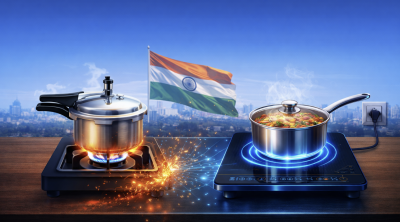
India faces a critical energy transition in cooking fuel use. Despite 332 million LPG connections, 37% of households still use firewood or dung. India spends $26.4 billion annually on LPG imports, mostly through the volatile Strait of Hormuz. Recent studies show electric cooking is cheaper and more efficient than unsubsidised LPG. However, switching millions of kitchens to electricity poses challenges for the power grid and subsidy policies.
Current Cooking Fuel Scenario
India imports 60% of its LPG and half of its natural gas. LPG connections doubled from 150 million in 2015 to 332 million in 2025. Yet, gas-based cooking faces affordability limits due to rising global prices. Electricity for cooking is 37% cheaper than unsubsidised LPG and 14% cheaper than piped natural gas in Delhi. LPG subsidies under PM Ujjwala Yojana reduce costs but burden the exchequer. Induction cooktops are 85% energy efficient compared to 40% for LPG burners. However, Indian cooking needs multi-pot induction models, which are still underdeveloped.
Electricity Demand and Grid Challenges
India’s peak electricity demand rose to 242.5 GW in 2025. Peak demand surges in the evening when households switch on appliances simultaneously. Adding millions of induction cooktops could worsen peak loads, raising costs and blackout risks. Discoms manage peaks by buying expensive spot power, running costly peaking plants, or load shedding. Smart demand response technologies like Open Automated Demand Response (OpenADR) can automatically reduce peak loads by controlling smart devices. Pilot projects show 7-14% peak reduction potential, but full infrastructure is yet to be built.
Role of Rooftop Solar and Peer-to-Peer Trading
Rooftop solar with battery storage can offset evening cooking peaks by supplying stored solar power. India’s rooftop solar capacity is expected to rise from 24 GW in 2026 to over 41 GW by 2030. The PM-Surya Ghar Yojana promotes solar adoption with free electricity units. Peer-to-peer (P2P) solar trading allows households to sell surplus power directly to neighbours, lowering costs and flattening peak demand. Successful pilots in Uttar Pradesh led to regulatory support and expansion plans for Delhi and western UP.
Policy and Future Directions
India aims to expand induction stove use under the Go Electric and National Efficient Cooking programmes. Star labelling for induction hobs and linking rooftop solar to household savings are underway. Suggestions include redirecting LPG subsidies to induction stove subsidies, mandating time-of-use tariffs, and requiring OpenADR compatibility in appliances. New building codes for all-electric constructions in Tier-1 cities are proposed. The shift reduces dependence on imported fuels and enhances energy sovereignty by promoting locally generated electricity.
Topics for Prelims:
Liquefied Petroleum Gas (LPG)
- India imports 60% of its LPG needs.
- LPG connections grew from 150 million (2015) to 332 million (2025).
- PM Ujjwala Yojana subsidises LPG for poor households.
- LPG burners have about 40% energy efficiency.
- Annual LPG import bill is $26.4 billion (FY24-25).
Electric Cooking Technology
- Induction cooktops transfer 85% energy to vessels.
- Electric cooking is 37% cheaper than unsubsidised LPG in Delhi.
- Multi-pot induction cooktops needed for Indian cooking styles.
- Open Automated Demand Response (OpenADR) manages peak loads.
- Energy Efficiency Services Limited promotes bulk procurement of e-cooking devices.
Rooftop Solar and Peer-to-Peer Energy Trading
- India’s rooftop solar capacity to grow from 24 GW (2026) to 41 GW (2030).
- PM-Surya Ghar Yojana provides free electricity units to households.
- P2P solar trading pilot in Lucknow reduced energy buy price by 43%.
- P2P trading allows direct electricity sales between households.
- Solar plus battery storage can reduce peak evening electricity demand.
Questions for Mains:
- Critically analyse the economic and strategic implications of India’s dependence on imported LPG and the shift to electric cooking. [GS-III-Economic Development]
- Explain the challenges of integrating mass electric cooking into India’s power grid and the role of smart grid technologies in addressing these challenges. [GS-III-Science & Technology]
- With suitable examples, comment on how rooftop solar and peer-to-peer energy trading can contribute to sustainable urban energy systems and energy democracy. [GS-III-Environment & Disaster Management]
- What are the policy measures necessary to promote clean cooking energy transitions in India, and how do they align with India’s energy security and environmental goals? Critically assess. [GS-II-Governance]
Answer Hints:
1. Critically analyse the economic and strategic implications of India’s dependence on imported LPG and the shift to electric cooking. [GS-III-Economic Development]
- India imports 60% of LPG, spending $26.4 billion annually, exposing it to price shocks from geopolitical tensions, especially in the Strait of Hormuz.
- Rising LPG import costs increase subsidy burden (PM Ujjwala Yojana), straining fiscal resources and affecting affordability for poor households.
- Electric cooking is 37% cheaper than unsubsidised LPG and more energy-efficient (85% vs 40%), promising cost savings and reduced import dependence.
- Shifting to electric cooking reduces vulnerability to global fuel price volatility, enhancing energy sovereignty through domestic electricity generation (especially solar).
- However, transition challenges include upfront costs, grid infrastructure upgrades, and ensuring equitable access in rural areas.
- Strategically, electric cooking aligns with India’s goal of reducing fossil fuel imports, strengthening energy security, and promoting sustainable development.
2. Explain the challenges of integrating mass electric cooking into India’s power grid and the role of smart grid technologies in addressing these challenges. [GS-III-Science & Technology]
- Mass adoption of induction cooktops will increase evening peak demand, risking grid overload, higher spot market prices, and potential blackouts.
- India’s peak demand rose to 242.5 GW (2025), with evening surges already stressing distribution companies (discoms).
- Current grid management options during peaks (spot purchases, peaking plants, load shedding) are costly and disruptive.
- Smart grid technologies like Open Automated Demand Response (OpenADR) enable automated load control, reducing peak demand by 7-14% in pilots.
- Full deployment requires infrastructure upgrades – OpenADR servers, smart meters, aggregator platforms, and household load capacity enhancement (3 kW to 5 kW).
- Smart grids facilitate demand-side management, improve grid stability, and enable consumer participation as active grid users.
3. With suitable examples, comment on how rooftop solar and peer-to-peer energy trading can contribute to sustainable urban energy systems and energy democracy. [GS-III-Environment & Disaster Management]
- Rooftop solar capacity in India is projected to grow from 24 GW (2026) to 41 GW (2030), supported by schemes like PM-Surya Ghar Yojana.
- Solar panels paired with batteries allow households to store daytime solar energy for evening cooking, reducing peak grid demand.
- Peer-to-peer (P2P) energy trading pilots (e.g., Lucknow blockchain-based project) enable households to sell surplus solar power directly to neighbors, lowering energy costs by 43%.
- P2P trading encourages decentralized energy markets, empowering consumers as ‘prosumers’ and promoting energy democracy.
- Such models flatten demand peaks, reduce reliance on expensive grid power, and encourage renewable energy integration.
- Regulatory support (Uttar Pradesh directives, India Energy Stack) is crucial for scaling P2P trading and sustainable urban energy systems.
4. What are the policy measures necessary to promote clean cooking energy transitions in India, and how do they align with India’s energy security and environmental goals? Critically assess. [GS-II-Governance]
- Redirect LPG subsidies (₹40,000 crore annually) towards capital support for induction cooktops to encourage electric cooking adoption.
- Expand bulk procurement models (EESL) for affordable e-cooking appliances and mandate star labelling for energy efficiency.
- Implement time-of-use tariffs and require OpenADR compatibility in new appliances and smart meters to optimize grid load management.
- Fund R&D on multi-pot and flame-replicating induction technology tailored to Indian cooking habits.
- Mandate all-electric construction in new residential buildings, especially Tier-1 cities, to institutionalize clean cooking infrastructure.
- These measures reduce dependence on imported fossil fuels, lower emissions, enhance energy sovereignty, and promote equitable access to clean energy.
- Challenges include ensuring rural electrification, affordability, consumer awareness, and aligning multiple stakeholders for policy implementation.