
India’s space programme has reached a phase where past successes no longer serve as sufficient benchmarks for future progress. Over the last decade, the Indian Space Research Organisation has built a reputation for reliability and ambition that far exceeds what might be expected from an agency of its size and budget. As ISRO prepares for human spaceflight, heavier launch vehicles, and deeper global collaboration, the central question today is not whether it can achieve technological milestones, but whether its institutions, governance structures, and industrial ecosystem are ready to sustain them.
Expanding mission depth beyond routine launches
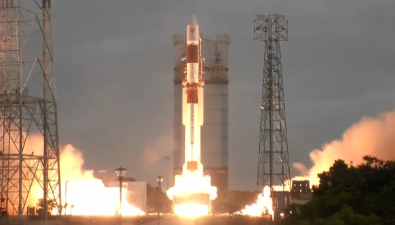
ISRO’s launch systems, particularly the “”, have provided India with consistent and reliable access to space. Over time, this dependability has made complex multi-satellite missions routine and enabled a gradual shift toward more demanding scientific and exploratory goals.
The successful soft landing of Chandrayaan-3 in August 2023 placed India among a select group of countries with proven lunar-landing capability. This was followed by Aditya-L1, which entered a halo orbit around the Sun–Earth L1 point in January 2024, marking India’s first dedicated solar observatory. In July 2025, ISRO further expanded its international footprint by launching the NASA-ISRO Synthetic Aperture Radar, a high-value collaboration designed to improve climate and hazard monitoring.
When consistency reshapes expectations
Sustained success has altered the standards by which ISRO is judged. Narratives of humble beginnings or constrained resources have given way to expectations of scale, speed, and predictability. Mastery over PSLV and GSLV operations has shifted attention toward what comes next: heavier payloads, faster turnaround times, and missions delivered as part of a steady operational rhythm rather than as isolated achievements.
With projects such as Gaganyaan, advanced lunar exploration, and the Next-Generation Launch Vehicle in development, ISRO is entering a phase where ambition must be matched by institutional capacity.
Execution capacity as the main constraint
One of ISRO’s most pressing challenges lies in prioritisation and execution. Preparing simultaneously for human spaceflight, advanced science missions, satellite replenishment, and the development of a new heavy-lift launch vehicle has strained its launch cadence and project timelines. A relatively low number of launches in recent years has been linked to this shift toward large, resource-intensive programmes.
The dependence of private launch providers on ISRO’s facilities further compounds the issue. Delays or anomalies in one mission can ripple across unrelated programmes. Addressing this requires expanded integration capacity, better access to test facilities, stronger industrial supply chains for critical components, and clearer internal mechanisms to determine which timelines can slip without paralysing the entire system.
Unfinished governance in a liberalised space sector
India’s space-sector reforms since 2020 envisage a clear separation of roles: ISRO as a research and capability-development agency, the “” as the authorising and promotional body, and “” as the commercial interface. While conceptually sound, this arrangement lacks firm statutory backing.
The absence of a comprehensive national space law leaves ambiguity around liability, insurance, dispute resolution, and authorisation. In practice, ISRO is often drawn back into a default regulatory role because it remains the most technically capable institution. A clear legal framework would not only encourage private participation but also shield ISRO from ad hoc responsibilities that dilute its focus on frontier research.
Competitiveness as an ecosystem challenge
Globally, the space sector is moving toward frequent launches, partial reusability, and rapid satellite manufacturing. India’s response cannot rely solely on technical ambition. The emphasis on payload capacity and reusability in the NGLV reflects an understanding that economic efficiency and agility are now central to competitiveness.
Yet, achieving this requires advanced manufacturing capabilities, deeper production lines, greater qualification capacity, and sustained capital investment. The decline in space-sector investment in 2024 underscored the difficulty of financing hardware-intensive projects with long development cycles. Recent funding initiatives aim to bridge this gap, but ecosystem maturity remains uneven.
Why sustained institutional performance matters
ISRO’s past accomplishments have earned it credibility and public trust. The next phase of India’s space journey, however, will depend less on individual milestones and more on sustained institutional performance. The ability to execute complex missions routinely, supported by clear governance and a mature industrial base, will determine whether India’s space ambitions translate into long-term strategic capability.
What to note for Prelims?
- Objectives and significance of Chandrayaan-3, Aditya-L1, and NISAR missions
- Role of PSLV and GSLV in India’s launch ecosystem
- Functions of IN-SPACe and NSIL under space-sector reforms
- Key features and objectives of the Next-Generation Launch Vehicle
What to note for Mains?
- Institutional and execution challenges facing ISRO amid expanding ambitions
- Need for a comprehensive national space law and its governance implications
- Limits of mission-centric success versus ecosystem-based competitiveness
- Interplay between technology, regulation, industry, and finance in India’s space sector