
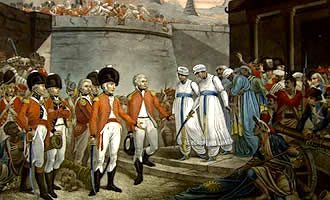

The Instrument of Accession was legal document in the history of India. It allowed princely states to join the newly formed Dominion of India or Pakistan in 1947. The framework was established by the Government of India Act of 1935. This act provided a method for princely states to accede to India.
Background
Before independence, India comprised 565 princely states. These states were not directly governed by the British Crown. Instead, they maintained a relationship through subsidiary alliances. The British faced challenges in managing these states during the transition to independence.
Legal Framework
The Instrument of Accession was introduced in the Government of India Act of 1935. It allowed rulers of princely states to join the Federation of India. The accession was based on three main subjects – defence, external affairs, and communications.
Indian Independence Act of 1947
The Indian Independence Act, enacted in July 1947, marked a very important moment. It declared that British suzerainty over princely states would end on August 15, 1947. This left the states with the choice to join either India or Pakistan.
Accession Process
For a princely state to accede, its ruler had to sign an Instrument of Accession. This document outlined the terms of accession and the subjects on which the Dominion could legislate. The ruler retained certain powers and sovereignty over the state.
Template of the Instrument of Accession
The Instrument of Accession followed a standard template. It included declarations by the ruler about their intention to accede. It also specified the subjects under which the Dominion could make laws for the state.
Key Provisions
The Instrument included several important provisions:
- Acceptance of the Government of India Act, 1935.
- Retention of the ruler’s sovereignty over the state.
- Conditions for future amendments to the Instrument.
- Assurance regarding land acquisition laws.
- Provisions for agreements between the ruler and the Dominion.
Significance of the Instrument
The Instrument of Accession was crucial for the integration of princely states into India. It provided a legal basis for accession and helped maintain order during the transition. The document symbolised the end of British colonial rule and the beginning of Indian sovereignty.
Accession of Jammu and Kashmir
One of the most notable cases was Jammu and Kashmir. Maharaja Hari Singh signed the Instrument of Accession on October 26, 1947. This accession was approved by Lord Mountbatten the following day. The accession remains a contentious issue in India-Pakistan relations.
Accession of Junagadh
Junagadh’s accession to Pakistan was controversial. Lord Mountbatten and Narasimha Gopalaswami Ayyangar believed the accession was legally valid. However, Sardar Patel argued that the people’s will should determine the state’s future. This brought into light the complexities of the accession process.
Role of the Governor-General
The Governor-General of India played important role in the accession process. They had the authority to approve the Instruments of Accession. Their approval was essential for the legitimacy of the accession.
Controversies Surrounding Accession
The accession of various princely states led to disputes. The most prominent was the case of Jammu and Kashmir. The legal and political arguments surrounding the accession have had lasting implications for India and Pakistan.
Impact on Indian Politics
The Instruments of Accession influenced Indian politics. They set the stage for the integration of princely states into the Indian Union. The process was a critical step in nation-building post-independence.
Integration of Princely States
The integration of princely states was not uniform. Some states acceded willingly, while others required persuasion. The government employed various strategies to encourage accession, including military action in some cases.
Post-Independence Developments
After independence, the Government of India worked to integrate princely states. This involved negotiations and, in some instances, military intervention. The aim was to create a unified nation.
Legislative Changes
Following the accession, the Indian Parliament enacted laws to solidify the integration of states. This included the abolition of privy purses and titles of the rulers. These changes aimed to eliminate feudal structures and promote equality.
Current Status of Princely States
Today, the legacy of the princely states continues to influence Indian politics. Some former rulers still play ceremonial roles. The history of accession remains a topic of interest in Indian historiography.
Instrument of Accession and International Law
The Instrument of Accession also raised questions in international law. The principles of self-determination and sovereignty were debated. The accession of Jammu and Kashmir, in particular, has been scrutinised by international bodies.


