
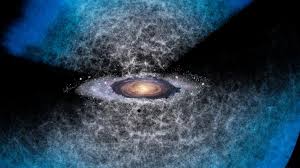
The idea that the universe may not be accelerating forever but could instead be slowing down has reopened one of cosmology’s deepest debates. A recent study by researchers at Yonsei University challenges the long-held belief that cosmic expansion is speeding up, forcing scientists to re-examine the nature of dark energy and the fate of the universe itself.
Why the New Claim Matters
For over two decades, cosmologists have worked with a remarkably successful framework — the (ΛCDM) model — which holds that the universe’s expansion is accelerating under the influence of dark energy. The Yonsei study, published in “Notices of the Royal Astronomical Society”, argues instead that this acceleration may already have peaked and begun to slow, a possibility that would alter our understanding of cosmic history and destiny.
How the Idea of an Accelerating Universe Emerged
Modern cosmology rests on the observation that the universe began around 13.8 billion years ago in a hot, dense Big Bang. After the initial expansion, gravity was expected to gradually slow things down. This assumption was overturned in 1998 when observations of distant exploding stars — Type Ia supernovae — revealed that the universe’s expansion had begun accelerating roughly 9 billion years after its birth.
These results built on the earlier discovery by Edwin Hubble that galaxies are moving away from one another, with speed increasing with distance. To explain the unexpected acceleration, scientists invoked dark energy, a mysterious component thought to make up nearly 70% of the cosmos. Its effects can be mathematically described using the cosmological constant first proposed by Albert Einstein.
Supernovae, Dark Energy and the Nobel Moment
The accelerating universe was confirmed through meticulous measurements of Type Ia supernovae, whose consistent brightness allows them to be used as “standard candles.” By combining brightness data with redshift measurements, astronomers could map how fast different regions of the universe are receding.
This work earned Saul Perlmutter, Brian Schmidt and Adam Riess the 2011 Nobel Prize in Physics. Their findings cemented dark energy as a central pillar of cosmology and strengthened confidence in the ΛCDM model.
What the Yonsei Study Argues
The new study suggests that dark energy may not be constant but instead weakens over time. According to its authors, once corrections are made for the ages of stars hosting Type Ia supernovae, the data indicate that cosmic expansion has entered a phase of deceleration.
This interpretation aligns with emerging observations from the Dark Energy Spectroscopic Instrument (DESI), which hint that supernova brightness may subtly depend on stellar population age. If confirmed, this would undermine the assumption that these explosions are perfectly uniform standard candles.
Why Cosmologists Are Divided
The response from the scientific community has been cautious. Many researchers argue that while the statistical signals are intriguing, they fall short of the threshold required to overturn a model that has successfully explained a vast range of observations — from the cosmic microwave background to galaxy clustering.
Some experts stress that current supernova analyses already correct for host galaxy properties such as mass and star formation history, which correlate with stellar age. From this perspective, the Yonsei result may reflect methodological choices rather than new physics.
What This Means for the Fate of the Universe
If dark energy truly evolves with time, the implications are profound. A weakening dark energy could eventually allow gravity to dominate, slowing expansion further and possibly reversing it in a distant future “Big Crunch.” Alternatively, the universe may still expand forever, but more gently than predicted.
Crucially, most scientists agree that such findings, even if validated, would modify rather than discard the standard cosmological model — refining our understanding of dark energy rather than replacing it outright.
What to Note for Prelims?
- ΛCDM model: combines dark energy (Λ) and cold dark matter.
- Type Ia supernovae are used as standard candles in cosmology.
- Dark energy accounts for about 70% of the universe’s energy content.
- DESI and large sky surveys study the expansion history of the universe.
What to Note for Mains?
- Critically examine the assumptions behind the ΛCDM model.
- Discuss how observational methods shape cosmological conclusions.
- Evaluate the implications of time-varying dark energy for cosmic fate.
- Link advances in astronomy to the philosophy of scientific models — provisional, yet powerful.
The Road Ahead in Observational Cosmology
The debate is far from settled. Next-generation observatories such as the and NASA’s are expected to deliver unprecedented data on supernovae, galaxies and dark energy. Whether they confirm a slowing universe or reinforce cosmic acceleration, they will sharpen our picture of a universe that continues to surprise — and humble — human understanding.
Last Modified: December 31, 2025