
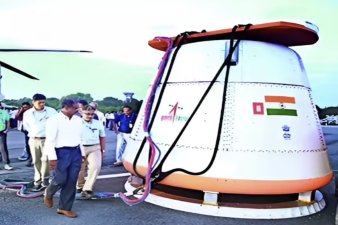
India’s space agency, ISRO, successfully conducted the second Integrated Air Drop Test (IADT-02) as part of the Gaganyaan mission. This test is crucial for validating the spacecraft’s crew module recovery system. Gaganyaan is India’s first human spaceflight programme, aiming to send Indian astronauts into low Earth orbit.
Purpose of the Integrated Air Drop Test
The Integrated Air Drop Test is designed to evaluate the parachute deployment and crew module descent mechanisms. It simulates the actual conditions during the spacecraft’s re-entry and landing phase. The test ensures the safety of astronauts by verifying the reliability of the parachute system and the soft-landing capability of the crew module.
Details of the Second Air Drop Test
In the IADT-02, the crew module mock-up was dropped from a helicopter at a predetermined altitude. The test involved the sequential deployment of drogue and main parachutes, followed by the activation of air bags to cushion the landing. The successful landing confirmed the effectiveness of the recovery system under real-time conditions.
Significance for the Gaganyaan Mission
The successful completion of IADT-02 is a critical milestone in the Gaganyaan mission timeline. It demonstrates ISRO’s progress in developing safe crew recovery technology. This test is part of a series of trials that will precede the actual human spaceflight, ensuring astronaut safety during splashdown or terrestrial landing.
Future Steps in the Gaganyaan Programme
Following the air drop tests, ISRO will focus on further validating onboard life support systems and crew module avionics. Preparations for uncrewed test flights are underway, which will test the entire launch and re-entry system. The Gaganyaan mission aims for a crewed launch within the next few years, marking a significant leap for India’s space capabilities.
What to Study for UPSC Exams?
- Spacecraft Recovery Systems
- Human Spaceflight Missions
- Parachute Deployment Mechanisms
- ISRO’s Mission Planning
- Low Earth Orbit Dynamics
Spacecraft Recovery Systems
Spacecraft recovery systems ensure safe return of vehicles and crew from space. They typically use heat shields, parachutes, and airbags for deceleration and cushioning. Early systems like Mercury used simple parachutes; modern designs integrate GPS and radar for precise landing. Recovery can be oceanic splashdowns or terrestrial landings depending on mission design.
Human Spaceflight Missions
Human spaceflight involves sending astronauts beyond Earth’s atmosphere. The first was Yuri Gagarin’s Vostok 1 in 1961. Missions require life support, radiation shielding, and re-entry protection. Long-duration flights face muscle atrophy and bone loss. International Space Station is the longest continuously crewed habitat in orbit.
Parachute Deployment Mechanisms
Parachute deployment uses sequential stages: drogue chutes stabilize and slow descent, followed by main chutes for final landing. Deployment can be pilot or automatic, triggered by altitude or velocity sensors. Materials have evolved from silk to Kevlar and nylon for strength and heat resistance.
ISRO’s Mission Planning
ISRO plans missions with phased testing: technology demonstrators, uncrewed flights, then crewed launches. It integrates indigenous tech with international collaborations. Mission timelines often span years, balancing cost, safety, and innovation. ISRO uses ground simulations and suborbital tests before orbital missions.
Low Earth Orbit Dynamics
Low Earth Orbit (LEO) ranges from 160 to 2,000 km altitude. Objects here orbit Earth roughly every 90 minutes. Atmospheric drag causes orbital decay, requiring periodic boosts. LEO is preferred for Earth observation, communication satellites, and human spaceflight due to lower launch energy needs.
Last Modified: April 10, 2026