
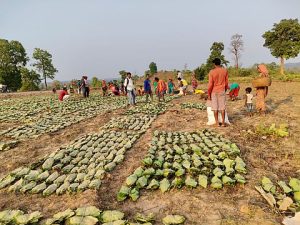
Eight Gram Sabhas in the Baipariguda block of Odisha’s Koraput district are awaiting important government notification. This notification is essential for the deregulation of kendu leaves trade. Known locally as “green gold,” kendu leaves are vital for local tribal economies. The Gram Sabhas have collected over 400,000 bundles this season. They aim to manage the trade independently under the Forest Rights Act (FRA) of 2006.
Importance of Kendu Leaves
Kendu leaves, also called tendu leaves in other regions, are for rolling beedis, a local hand-rolled cigarette. They possess medicinal properties and provide essential income for tribal communities. The leaves are harvested from non-designated collection areas, ensuring that local harvesting does not infringe upon Forest Department operations.
Legal Framework – Forest Rights Act
The Forest Rights Act (FRA) of 2006 recognises the rights of forest-dwelling communities. It allows them to collect, use, and sell minor forest produce, such as kendu leaves. A 2012 amendment clarified that these communities can process, store, transport, and sell forest produce without incurring royalties or fees. The Community Forest Rights Management Committee (CFRMC) is responsible for issuing transit permits, reinforcing these rights.
Economic Impact of Deregulation
Deregulation of kendu leaf trade is vital for improving local economies. Previous deregulation efforts in districts like Nabarangpur and Kalahandi have shown income increases for tribal collectors. Last year, the lack of a deregulation notification resulted in losses of approximately Rs 36 lakh due to rain damage. This marks the urgency for timely government action.
Community Voices and Resilience
Local tribal leaders, such as Parbati Khila, have voiced the importance of harvesting kendu leaves for vulnerable groups, including single women and widows. Bidyut Mohanty, from a local nonprofit advocating for tribal rights, emphasised that failure to deregulate would exacerbate economic hardships for these communities. The Gram Sabhas have expressed determination to secure their rights under the FRA.
Government Support and Capacity Building
A meeting in February 2022, chaired by Odisha’s Chief Secretary, reiterated that Gram Sabhas with CFR rights could trade kendu leaves independently. It also brought into light the need for capacity-building initiatives to support these communities. However, despite assurances, the anticipated deregulation in Baipariguda has not yet occurred.
Future Prospects
The Gram Sabhas remain hopeful for a positive outcome this season. They have worked diligently to claim their rights under the law. The community’s resilience and commitment to self-management are crucial for their economic wellbeing.
Questions for UPSC:
- Discuss the significance of the Forest Rights Act in empowering tribal communities in India.
- Critically examine the economic implications of non-timber forest products on local tribal economies.
- What is the role of community forest rights in sustainable forest management? Explain with examples.
- Comment on the impact of government policies on the livelihoods of indigenous populations in India.
Answer Hints:
1. Discuss the significance of the Forest Rights Act in empowering tribal communities in India.
- The Forest Rights Act (FRA) of 2006 recognizes the rights of forest-dwelling communities, allowing them to access and manage forest resources.
- It empowers tribal communities by granting them rights to collect, use, and sell minor forest produce, enhancing their economic status.
- The 2012 amendment further clarified that communities can process and trade forest products without incurring royalties or fees.
- FRA provisions override conflicting state laws, ensuring tribal rights are prioritized in forest management.
- Successful implementation of FRA has led to improved livelihoods and increased income for tribal collectors in various districts.
2. Critically examine the economic implications of non-timber forest products on local tribal economies.
- Non-timber forest products (NTFPs), like kendu leaves, provide a vital source of income for tribal communities, supporting their livelihoods.
- NTFPs contribute to food security and nutrition by offering diverse products for consumption and trade.
- Economic dependence on NTFPs can lead to vulnerability, especially if trade is regulated or restricted by government policies.
- Successful deregulation of NTFP trade has historically resulted in increased incomes for tribal collectors, as seen in Nabarangpur and Kalahandi.
- NTFPs also play a role in preserving traditional knowledge and practices related to sustainable resource management.
3. What is the role of community forest rights in sustainable forest management? Explain with examples.
- Community forest rights (CFR) empower local communities to manage and protect their forest resources sustainably.
- CFR promotes participatory governance, allowing communities to make decisions regarding resource use and conservation.
- Examples like the successful management of forests in Nabarangpur and Kalahandi demonstrate improved forest health and biodiversity under community stewardship.
- CFR can reduce deforestation and promote sustainable practices by aligning community interests with conservation goals.
- Recognizing CFR leads to greater accountability and responsibility among local communities for forest management.
4. Comment on the impact of government policies on the livelihoods of indigenous populations in India.
- Government policies can influence the economic stability and rights of indigenous populations, often determining access to resources.
- Policies like the FRA aim to empower tribal communities, but inconsistent implementation can lead to economic hardships, as seen in Baipariguda.
- Failure to deregulate trade of forest products can result in substantial financial losses, affecting livelihoods and community resilience.
- Supportive policies can enhance capacity-building initiatives, enabling communities to manage resources effectively and sustainably.
- Positive government engagement can lead to improved livelihoods and socio-economic conditions for indigenous populations through better resource management.