
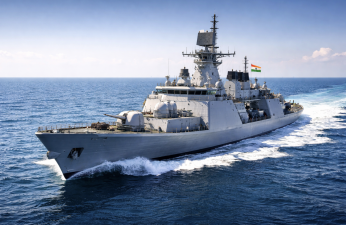
India’s maritime indigenisation drive marked a fresh milestone with the launch of Yard 18003 — Krishna — the first of three Cadet Training Ships (CTS) being built at L&T’s Kattupalli shipyard near Chennai. Designed and constructed indigenously, the vessel reflects the Navy’s emphasis on self-reliance, officer training capacity, and long-term maritime capability building under the Aatmanirbhar Bharat framework.
What Is Yard 18003 (Krishna)?
Yard 18003 Krishna is the first of three Cadet Training Ships under construction by Larsen & Toubro (L&T) at its Kattupalli shipyard in Chennai.
The vessel was launched on 16 February 2026 in the presence of Anil Chauhan, Chief of Defence Staff. Formal delivery to the Indian Navy is expected by the end of 2026.
As a Cadet Training Ship, Krishna will serve as a sea-based training platform for:
- Officer cadets after their basic training ashore.
- Women officer cadets.
- Cadets from friendly foreign nations.
Such ships provide hands-on exposure to seamanship, navigation, communication systems, and operational drills.
Why Cadet Training Ships Matter
Modern naval training requires practical exposure beyond classroom instruction. Sea training enables cadets to:
- Understand shipboard discipline and command structures.
- Learn navigation and maritime operations in real-time conditions.
- Develop leadership and teamwork skills.
- Gain exposure to multinational engagement missions.
Dedicated training platforms reduce dependence on frontline warships for instructional duties, thereby enhancing operational readiness.
Indigenous Shipbuilding and Strategic Autonomy
The CTS programme aligns with India’s broader push for indigenisation in defence manufacturing.
India’s naval shipbuilding has significantly expanded over the past decade, with warships, submarines, aircraft carriers, and auxiliary vessels increasingly built domestically. The launch of Krishna reinforces:
- Strengthening of private sector participation in defence.
- Development of indigenous design and engineering capability.
- Reduced reliance on foreign shipyards.
Under the Aatmanirbhar Bharat and Make in India initiatives, the Navy aims to maximise domestic content in all new acquisitions.
Role of the Private Sector in Naval Modernisation
The involvement of L&T’s Kattupalli shipyard highlights the growing role of private industry in strategic sectors traditionally dominated by public shipyards.
Private shipyards contribute through:
- Advanced modular construction techniques.
- Improved efficiency and timelines.
- Technology absorption and innovation.
This diversification strengthens India’s defence industrial base and enhances export potential.
Training Diplomacy and Friendly Foreign Countries
The CTS will also train cadets from friendly foreign countries, adding a diplomatic dimension to the platform.
Naval training cooperation fosters:
- Military-to-military engagement.
- Trust-building among partner nations.
- India’s profile as a regional maritime leader.
Such initiatives complement India’s vision of being a net security provider in the Indian Ocean Region (IOR).
What to Note for Prelims?
- Yard 18003 (Krishna) — first of three Cadet Training Ships.
- Built by L&T at Kattupalli, Chennai.
- Delivery expected by end 2026.
- Supports Aatmanirbhar Bharat and Make in India in defence.
What to Note for Mains?
- Role of indigenous shipbuilding in India’s maritime security.
- Private sector participation in defence production.
- Importance of naval training for operational preparedness.
- Defence diplomacy through training of foreign cadets.
- Strategic autonomy and indigenisation in defence policy.