
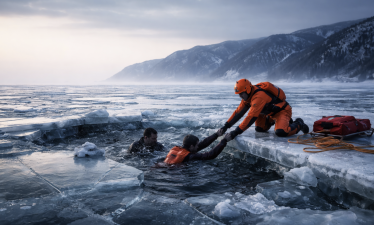
The death of seven tourists after a bus broke through the frozen surface of [“Lake Baikal”,”russia”] has once again drawn attention to the risks associated with winter tourism in extreme climatic zones. The incident, involving Chinese nationals in [“Siberia”,”russian region”], underscores the intersection of tourism growth, environmental hazards, and regulatory oversight in fragile ecosystems.
What Happened on the Frozen Lake?
On Friday, a tour bus carrying eight Chinese tourists attempted to cross the frozen surface of Lake Baikal when the ice cracked, causing the vehicle to plunge into the water. According to emergency authorities, seven bodies have been recovered, while one tourist managed to escape.
The depth at the accident site is approximately 18 metres, complicating rescue and recovery efforts. Underwater cameras were deployed, and diving operations were planned to retrieve the submerged vehicle and bodies. The regional prosecutor’s office has initiated a criminal investigation into the circumstances of the accident.
Lake Baikal: Geography, Climate and Tourism
Located in eastern Siberia, north of [“Mongolia”,”sovereign state in asia”], Lake Baikal is widely recognised as the world’s deepest and oldest freshwater lake. It holds nearly one-fifth of the world’s unfrozen surface freshwater reserves and is a UNESCO World Heritage Site due to its unique biodiversity.
During winter, the lake freezes over with thick ice sheets, often attracting tourists for:
- Ice-driving expeditions
- Winter photography tours
- Adventure tourism activities
- Cultural tourism in surrounding Siberian settlements
While the ice can reach substantial thickness, it is not uniformly stable. Variations in temperature, underwater currents, and pressure ridges can create weak points, posing significant risks.
Surge in Chinese Tourism to Russia
In recent years, Chinese tourism to [“Russia”,”eurasian country”] has grown rapidly. This expansion has been facilitated by improving bilateral ties and the introduction of a mutual visa-free travel regime for group tours.
Regions such as [“Irkutsk”,”city in russia”], which serves as a gateway to Lake Baikal, have benefited economically from this inflow. The regional governor, [“Igor Kobzev”,”irkutsk governor”], confirmed details of the accident through official communication channels, highlighting the seriousness of the event.
The tragedy raises questions about:
- Safety standards for tour operators
- Regulation of winter transport across frozen water bodies
- Emergency preparedness in remote regions
Legal and Regulatory Dimensions
The launch of a criminal investigation signals possible violations of safety norms. In Russia, regional authorities regulate tourism and transport operations, especially in environmentally sensitive zones.
Key regulatory concerns include:
- Whether the bus operator had official permission to traverse the ice.
- Whether ice thickness and safety conditions were properly assessed.
- Compliance with local disaster management protocols.
Such incidents often lead to stricter enforcement measures, seasonal restrictions, and mandatory safety certifications for operators.
Environmental and Climate Concerns
Lake Baikal’s ice cover has shown increasing variability due to climate change. Warmer winters and fluctuating temperatures reduce predictability in ice formation and thickness. For UPSC aspirants, this incident also connects to broader themes:
- Impact of global warming on cryospheric systems
- Risks of commercial exploitation of fragile ecosystems
- Balancing economic gains from tourism with environmental safety
Extreme weather regions demand adaptive regulatory mechanisms, especially when tourism activities involve direct engagement with natural formations like frozen lakes.
What to Note for Prelims?
- Lake Baikal is the world’s deepest freshwater lake and a UNESCO World Heritage Site.
- It is located in Siberia, north of Mongolia.
- It holds about 20% of the world’s unfrozen freshwater reserves.
- Winter ice thickness can vary significantly due to climatic conditions.
What to Note for Mains?
- Discuss the challenges of regulating adventure tourism in ecologically fragile regions.
- Examine the impact of climate variability on cryospheric stability and disaster risks.
- Analyse the role of bilateral relations and visa regimes in shaping tourism flows.
- Evaluate disaster preparedness and accountability mechanisms in remote geographies.