
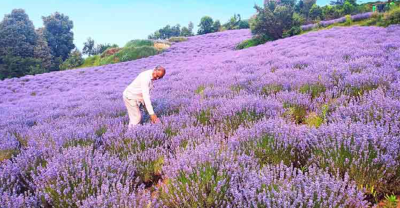
The two-day 4th Mega Lavender Festival concluded successfully on June 7, 2026, at Government Degree College Bhaderwah in the Doda district of Jammu and Kashmir. Organized by the CSIR-Indian Institute of Integrative Medicine (CSIR-IIIM) Jammu, the event operated under the central theme “Lavender Goes Global.” The festival brought together farmers, scientists, agri-entrepreneurs, and industrial buyers to evaluate the commercial progression of the “Purple Revolution” in the Chenab Valley. Technical sessions conducted by experts focused on advanced cultivation techniques, essential oil processing, value addition, and strategies to scale up the local aroma economy.
The Purple Revolution and Bhaderwah Ecosystem
Geographical Suitability and Transition
Bhaderwah, frequently referred to as India’s “Lavender Capital,” features temperate climatic conditions, specific altitude profiles, and hilly terrains ideal for growing lavender (Lavandula angustifolia). Small and marginal farmers in this mountainous region have systematically transitioned from traditional, low-remunerative crops like maize to high-value aromatic plants.
Economic Impact and Scaling
- Acreage Expansion: Lavender cultivation has expanded to encompass nearly 1,500 hectares of land across the region.
- Farmer Incomes: The shift to aromatic farming has benefited over 4,500 farming families, providing a resilient and sustainable source of rural income.
- Oil Yield and Revenue: The collective initiative has produced more than 4,000 kilograms of pure, high-grade lavender essential oil, generating a cumulative revenue surpassing ₹18 crore.
- Employment Generation: The distillation, processing, packaging, and marketing segments have generated employment opportunities for non-farm rural youth and women self-help groups.
CSIR Aroma Mission: Core Framework
Mandate and Phase Implementation
The Council of Scientific and Industrial Research (CSIR) launched the Aroma Mission to catalyze the growth of the aromatic sector through targeted technological interventions. The mission aims to bring additional land under the cultivation of essential oil-bearing crops, meeting the raw material demands of the domestic perfume, cosmetics, and pharmaceutical industries.
Multi-Dimensional Components of the Mission
| Functional Vertical | Core Deliverable Activities |
| Agro-Technology Transfer | Supply of high-quality, disease-free planting material to farmers. |
| Infrastructure Support | Installation of field-level, community-operated steam distillation units. |
| Skill Development | Technical training on crop management, harvesting cycles, and oil extraction. |
| Market Linkages | Establishing direct Buyer-Seller meets to eliminate intermediary exploitation. |
| Value Addition | Development of downstream products like soaps, room fresheners, and hydrosols. |
Convergence with Agri-Startups and Tourism
Entrepreneurship via Agri-Startups
The technological backing from CSIR-IIIM has triggered a surge in rural startups. Young entrepreneurs are setting up micro-distilleries and launching specialized brands for lavender-infused products. This growth demonstrates that agro-based innovation provides viable alternatives to conventional information technology startups.
Lavender Agro-Tourism
The blooming season transforms the landscapes of the Chenab Valley into expansive purple fields, creating a niche market for eco-tourism. The integration of lavender cultivation with local tourism enhances seasonal hospitality earnings, promotes homestays, and expands the market for regional handicraft and handloom products.
IASPOINT Booster Facts for UPSC
- CSIR Aroma Mission: Launched in 2016, the mission is implemented primarily by four key laboratories: CSIR-Central Institute of Medicinal and Aromatic Plants (CSIR-CIMAP), Lucknow; CSIR-IIIM, Jammu; CSIR-Institute of Himalayan Bioresource Technology (CSIR-IHBT), Palampur; and CSIR-North East Institute of Science and Technology (CSIR-NEIST), Jorhat.
- Nodal Scientific Institution: CSIR-CIMAP serves as the overall nodal laboratory for the pan-India implementation of the Aroma Mission.
- Rashtriya Vigyan Puraskar: In recognition of its transformative societal impact, the CSIR Aroma Mission was awarded the prestigious Vigyan Team Award at Rashtrapati Bhavan.
- Target Essential Oil Crops: Besides lavender, the mission focuses on other economically viable species including Lemongrass, Palmarosa, Citronella, Geranium, Mint varieties, and Patchouli.
- Purple Revolution Nodal Area: While it has now spread to other hilly districts of Jammu and Kashmir, including Ramban, Kathua, Udhampur, and Anantnag, the movement officially originated in the temperate zones of Doda district (Bhaderwah).
- Industrial Synergy: Lavender oil is highly valued in aromatherapy, food preservation, therapeutic cosmetics, and pharmaceutical formulations due to its natural antimicrobial and sedative properties.
